




A Mission to an Ocean World
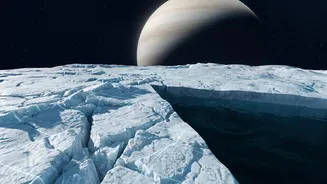
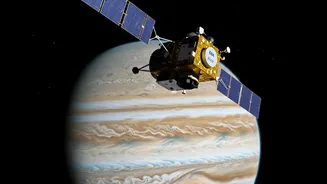
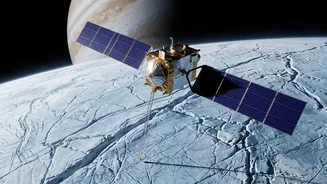
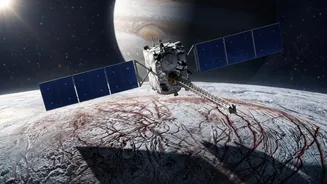
NASA's Europa Clipper spacecraft is embarking on a historic journey to investigate whether Jupiter's icy moon could harbor conditions suitable for life. The main goal isn't to find life itself, but to determine if the ingredients for it—water, chemistry,
and energy—exist in this distant world. Evidence strongly suggests that a global ocean, potentially containing more than twice the water of all of Earth's oceans combined, is sloshing beneath miles of ice. To peer beneath this frozen veil, the spacecraft is equipped with a suite of nine advanced scientific instruments, but one is uniquely designed for deep reconnaissance. This mission will conduct dozens of close flybys, some as low as 25 kilometers (16 miles) above the surface, to gather detailed measurements and create a comprehensive map of this enigmatic moon.
Introducing REASON: The Mission's Eyes
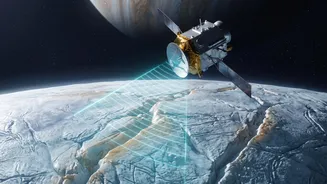
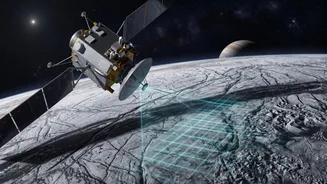
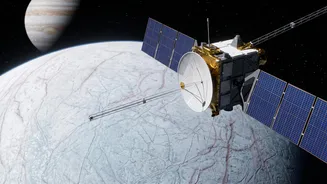
The key to unlocking Europa's secrets lies with an instrument named REASON, which stands for Radar for Europa Assessment and Sounding: Ocean to Near-surface. This sophisticated ice-penetrating radar is the only instrument aboard the Clipper that can look directly into the moon's icy shell. Developed by researchers who honed similar technology studying Antarctica's ice sheets, REASON is designed to function as a geological scanner, providing the first direct measurements of the ice shell's structure from top to bottom. It is a crucial piece of technology that will give scientists a three-dimensional view of what lies beneath Europa's fractured, frozen surface.
How the Radar Sees Through Ice
REASON works by sending out radio waves from its antennas and then listening for the echoes that bounce back. Think of it like a highly advanced geological ultrasound. Different frequencies of radio waves are used; very high frequency (VHF) waves at 60 MHz provide a detailed look at the shallower parts of the ice, while high frequency (HF) waves at 9 MHz are designed to penetrate much deeper. Ice is relatively transparent to these radio waves, but they reflect strongly off liquid water or significant changes in material, like boundaries between different ice layers or pockets of slush. By measuring the time it takes for the signal to return, scientists can calculate the depth of these features. The strength of the returning signal reveals information about the material itself, allowing the team to distinguish between solid ice and a potential liquid ocean.
Searching for Water and Chaos
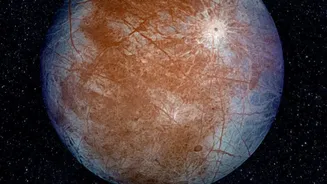
The primary objective for REASON is to find the boundary between the ice shell and the ocean below, and to measure how thick that shell is. It is designed to probe as deep as 18 miles (30 kilometers) into the ice. But scientists are also looking for other tantalizing features. The radar will search for pockets of water, like subsurface lakes, that might be trapped within the icy shell itself. These could be crucial environments, potentially connecting the surface to the deep ocean and playing a role in the moon's geology. The instrument will also analyze features on the surface, such as ridges and chaotic terrain, to see how they relate to the structures it detects below. This will help build a complete picture of the dynamic processes shaping the moon.
More Than Just an Ocean Finder
While finding the ocean is a top priority, REASON's capabilities extend further. The instrument will also function as an altimeter, precisely measuring the topography of Europa's surface to characterize its roughness. These measurements can help identify scientifically interesting sites for a potential future lander mission. Furthermore, by taking repeated measurements over time, REASON can detect subtle changes in the surface height caused by the gravitational tug of Jupiter. These tides can reveal how flexible the ice shell is, providing more clues about its thickness and the properties of the ocean beneath it. The instrument can even help search for signs of active water plumes erupting from the surface by studying their effect on Europa's ionosphere.