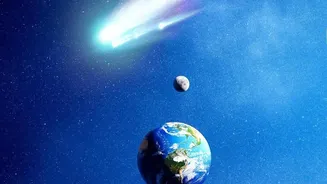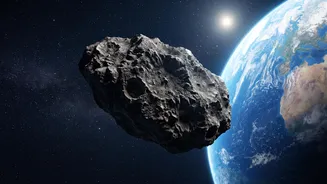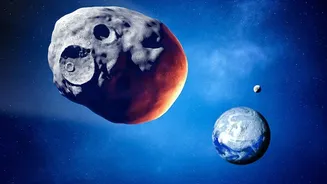


It’s a lonely universe out there, but for a little while, Earth has some extra company. Our planet’s gravity has captured a tiny asteroid, giving us a temporary 'minimoon'. But this visitor won't be staying long.
Meet Our Newest Companion
Astronomers have confirmed that a small
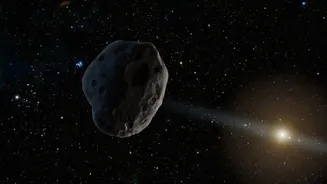
asteroid, officially designated 2026 QQ8, was captured by Earth's gravity in April 2026. First spotted in August by Hungarian astronomer Krisztián Sárneczky, the object measures only about two meters (around six feet) in diameter. After weeks of observation to confirm it wasn't a piece of old satellite or rocket debris, the International Astronomical Union's Minor Planet Center officially logged the newcomer in late October. This celestial visitor is expected to remain in Earth's orbit until early December 2026, or possibly January 2027, before its trajectory slingshots it back into an orbit around the sun. Because of its small size and distance—orbiting at about 1.5 times farther than our main Moon—it poses no threat and is far too dim to be seen without powerful telescopes.
What Exactly Is a Minimoon?
The term 'minimoon' isn't an official astronomical classification, but it’s a useful nickname for any natural object temporarily captured by a planet's gravity. These are typically small asteroids that get pulled into a planet's gravitational field, or 'Hill sphere', where the planet's pull is stronger than the Sun's. To be captured, an asteroid needs to approach Earth at a very low relative speed and on an orbit that is very similar to our own. Most of these captures are short-lived. A typical minimoon might stick around for several months and complete a few chaotic orbits before the Sun’s gravity inevitably pulls it away again. Simulations suggest that at any given time, Earth likely has at least one minimoon about one meter in size, but they are incredibly difficult to detect due to their small size and speed.
Natural Asteroid or Space Junk?
One of the first challenges after spotting a potential minimoon is determining its origin. Distinguishing a natural space rock from a piece of human-made space debris can be tricky. A famous case was the object 2020 SO, which was temporarily captured in late 2020. Its low velocity and unusual orbit immediately made astronomers suspicious. Further analysis showed that pressure from solar radiation was pushing the object around, indicating it was hollow and light, not a dense rock. Scientists eventually confirmed it was the Centaur rocket booster from the failed 1966 Surveyor 2 moon mission, finally making a return trip decades later. In the case of 2026 QQ8, astronomers used powerful telescopes to observe how sunlight affected its path over several weeks, confirming it behaved like a solid, natural asteroid.
The Inevitable Goodbye
A minimoon’s orbit is never stable. These objects are in a constant gravitational tug-of-war between the Earth, the Moon, and the Sun. Eventually, the Sun always wins. The orbits of minimouns are often chaotic and looping, influenced by their entry point into Earth's gravitational sphere. 2026 QQ8 entered Earth's orbit in April and will make a few loops before it is ejected. Its departure, expected in early 2027, will see it leave Earth's Hill sphere and resume its own independent orbit around the Sun. While this particular visit is temporary, 2026 QQ8 has an orbit that brings it close to Earth roughly every 10 years, so it may be captured again in the distant future, though its next close pass in 2058 won't be quite close enough for another capture.
More Visitors to Come
While only a handful of minimoons have been officially observed and confirmed, scientists believe they are common visitors. The reason we haven't seen more is simply because they are so small, dark, and fast-moving. However, with the advent of powerful new survey telescopes like the Vera C. Rubin Observatory in Chile, which scans the entire southern sky every few days, our ability to detect these fleeting companions is rapidly improving. Studying these objects provides a valuable opportunity to learn more about the population of near-Earth asteroids, including their composition and origin. They are samples of our cosmic neighborhood delivered right to our doorstep, reminding us that even in the vastness of space, we are never truly alone.