




The Moon’s Hidden Reservoirs
For decades, the Moon was thought to be bone-dry. We now know better. Data from missions like India's Chandrayaan-1 and NASA's LCROSS impactor confirmed the presence of water ice, but not in lakes or rivers. This water is trapped in shadowed craters near
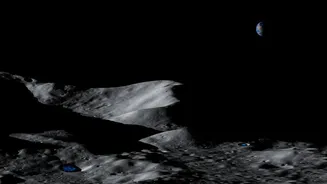
the lunar poles, some of which haven't seen sunlight in billions of years. These permanently shadowed regions (PSRs) are some of the coldest places in the solar system, preserving the ice mixed in with lunar soil, or regolith. The Artemis program is targeting the lunar south pole specifically to investigate these deposits, which could be a game-changer for establishing a long-term human presence.
The Challenge of Mining the Moon
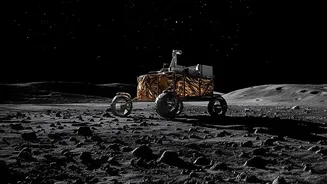
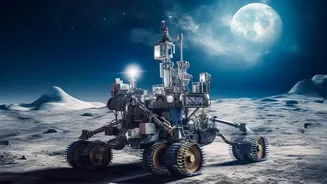
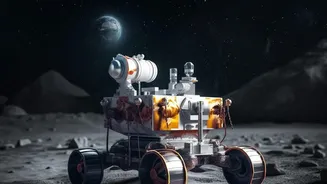
Extracting this resource is a monumental engineering challenge. The ice isn't a solid block but is intermingled with soil, possibly as fine grains or thicker layers, and it exists in a near-perfect vacuum at temperatures below -200°C. Several methods have been proposed to get it out. One common concept involves robotic rovers that could drill into the regolith and heat it, causing the water ice to sublimate directly into vapor. This vapor would then be captured in a cold trap, where it refreezes into more purified ice. Other novel approaches, like using microwave heating or low-energy grain sorting, are also being explored to make the process more efficient and reduce the immense power required for thermal extraction. Missions like NASA's now-canceled VIPER rover were designed to be the first step: mapping the ice's concentration and location to figure out where mining is even feasible.
From Water Ice to Rocket Fuel
Once collected, turning water into high-powered rocket fuel is surprisingly straightforward chemistry that has been understood for over a century. The process is called electrolysis. Using electricity, likely generated by solar panels deployed in nearby sunlit areas, water (H₂O) can be split into its constituent elements: hydrogen and oxygen. When these elements are stored in liquid form—liquid hydrogen (LH2) as the fuel and liquid oxygen (LOX) as the oxidizer—they create one of the most efficient and powerful chemical rocket propellants known. This is the same type of fuel that powered the upper stages of the massive Saturn V rockets during the Apollo era. Demonstrating this process on the Moon is a key goal for several upcoming missions from both national agencies and private companies.
A Gateway to the Solar System
The ability to refuel in space would fundamentally alter the economics of exploration. Launching mass from Earth is extremely expensive; one estimate puts the cost around $10,000 per pound. Much of a rocket's initial mass is the fuel needed just to escape Earth's gravity. If a spacecraft could launch with lighter fuel tanks and top up at a lunar depot, it could carry significantly larger payloads—more scientific instruments, habitats, or supplies—to destinations like Mars. Because the Moon's gravity is only one-sixth that of Earth, launching from the lunar surface to deep space requires far less energy. This turns the Moon from merely a destination into a critical piece of infrastructure, a 'gas station' that makes the entire solar system more accessible.
The New Lunar Gold Rush
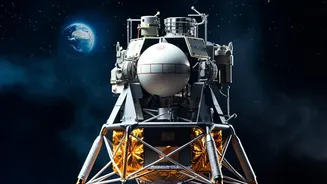
This potential has ignited a new kind of space race, driven as much by commerce as by national prestige. NASA's Artemis program is foundational, but a host of private companies are also developing the technologies needed for what some call the emerging 'cislunar economy'. Companies like Argo Space, Starpath, and Lockheed Martin are all working on concepts for water extraction, processing, and transportation. Others, like Blue Origin, are developing landers and in-situ resource utilization (ISRU) systems. While the technical and economic hurdles remain significant, the consensus is growing: the first company to successfully and affordably produce propellant on the Moon won't just be supporting science, they'll be fueling a new industrial frontier.