


Harnessing the Power of Light
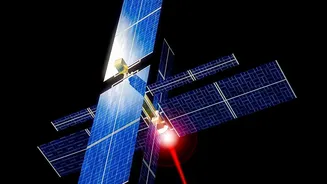
A solar sail works much like a sailboat uses wind, but its 'wind' is sunlight. Light is made up of particles called photons. While photons have no mass, they possess momentum as they travel through space. When countless photons from the sun strike a solar sail's
vast, mirror-like surface, they transfer their momentum to the sail, giving it a gentle but continuous push. This constant pressure, though incredibly slight, is enough to steadily accelerate a spacecraft in the frictionless vacuum of space. Because it relies on the endless supply of sunlight within a solar system, the sail doesn't need to carry heavy propellant, which is a major limitation for conventional rockets.
The Physics of the Reflective Push
The key to a solar sail's efficiency is its reflective surface. When a photon hits the sail and is absorbed, it imparts a certain amount of momentum. However, when it bounces off the reflective surface, like a ball bouncing off a wall, it transfers nearly double the momentum. This is due to the principles of momentum conservation; the sail gets a push from the initial impact and a second kick from the photon pushing off it to travel in the opposite direction. This is why solar sails are engineered to be giant, highly reflective mirrors rather than dark, absorbent panels. Maximizing this reflection is crucial for generating as much thrust as possible from the faint pressure of sunlight.
The Tortoise Versus the Hare
In the race of space travel, conventional chemical rockets are the hare. They provide an immense, powerful burst of thrust to escape Earth's gravity and set a course, but their fuel is finite and quickly consumed. Solar sails are the tortoise. Their initial acceleration is minuscule—The Planetary Society's LightSail 2 was pushed with a force equivalent to the weight of a paperclip. However, this push is constant. Over weeks, months, and years, this relentless acceleration allows a solar sail to build up tremendous speeds, potentially surpassing what a chemical rocket could achieve on a long journey. This makes them ideal for long-haul missions to the outer solar system and, one day, perhaps even to other stars.
Engineering the Perfect Mirror
Building an effective solar sail presents significant engineering challenges. The material must be incredibly lightweight, durable, and almost perfectly reflective. Most current sails are made from materials like Mylar or polyimide, coated with an ultra-thin layer of aluminum and sometimes thinner than a human hair. The Planetary Society's LightSail 2, for instance, used a Mylar sail just 4.5 microns thick. The sail also needs to be enormous—often covering an area the size of a boxing ring or larger—to catch enough photons. Researchers are now exploring advanced materials like graphene-infused composites and intricately patterned surfaces to create sails that are stronger, lighter, and can withstand closer passes to the sun for an even greater speed boost.
From Theory to the Stars
Solar sailing is no longer just science fiction. Japan's IKAROS probe successfully demonstrated the technology on its journey toward Venus in 2010. The Planetary Society’s crowdfunded LightSail 2 mission also proved the concept in Earth orbit from 2019 to 2022, using sunlight to actively change its orbit. Looking ahead, NASA has several solar sail missions in development, such as Solar Cruiser, which will use a massive 1,653 square-meter sail for heliophysics research. While the sun's push weakens with distance, some ambitious concepts like Breakthrough Starshot propose using powerful ground-based lasers to propel tiny sails toward nearby stars at up to 20% the speed of light, a journey that could take just 20 years instead of tens of thousands.