



The Old Man of the Forest
Deep within the Western Ghats, a silent, thoughtful primate with a magnificent silver-white mane peers through the leaves. This is the Lion-tailed Macaque, or ‘wanderoo’. An arboreal species, it spends almost its entire life in the canopy, feeding on fruits,
insects, and small vertebrates. Unlike other macaques, they are shy and reclusive, with a distinct call that echoes through the dense foliage. Their striking appearance and dwindling numbers—they are an endangered species—make a sighting an incredibly rare and poignant experience. Their existence is intrinsically linked to the evergreen forests, making them a flagship species for the conservation of this unique habitat. Look for them in protected areas like Kerala's Silent Valley National Park or Tamil Nadu's Kalakkad Mundanthurai Tiger Reserve.
The Rainbow in the Treetops
Catch a flash of crimson, cream, and deep maroon leaping between branches, and you’ve likely spotted the Malabar Giant Squirrel. Also known as the Indian Giant Squirrel, this is not your average park-dweller. Growing up to three feet long, tail included, it’s one of the largest squirrel species in the world. These vibrant rodents are masters of the high canopy, often building multiple nests, or ‘dreys’, across their territory. Their diet consists of fruits, flowers, and bark, and they play a vital role in seed dispersal. Their bright, multi-coloured coat isn’t just for show; it provides excellent camouflage against the dappled light of the forest. They are relatively common in the forests of peninsular India, and a patient eye can often spot them in places like Bhimashankar Wildlife Sanctuary in Maharashtra.
The Farmer of the Forest
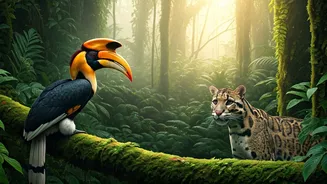
You often hear it before you see it: a powerful ‘whoosh-whoosh’ sound that reverberates through the air. This is the sound of the Great Hornbill’s massive wings in flight. With its huge yellow-and-black beak topped with a distinctive casque, this bird is an unforgettable sight. As one of the largest hornbills, it’s often called the ‘farmer of the forest’ for its role in dispersing seeds of fruit trees, which are crucial for forest regeneration. They form monogamous pairs and have a unique nesting behaviour where the female seals herself into a tree cavity to lay eggs, relying entirely on the male for food. Spotting a pair in flight is a majestic spectacle, a true symbol of the wildness of India’s forests, from the Western Ghats to the foothills of the Himalayas.
The Ghost of the Eastern Himalayas
Few creatures embody the mystery of the rainforest like the Clouded Leopard. Named for its beautiful, cloud-like coat pattern, this feline is one of the most secretive and elusive predators in Asia. It is a phenomenal climber, with rotating rear ankles that allow it to climb down trees headfirst, and a long tail that provides balance for life in the canopy. It’s neither a true leopard nor a small cat, but a unique species that bridges the gap between big and small felines. Sightings are extraordinarily rare, making it a near-mythical creature for wildlife enthusiasts. The dense, wet forests of Northeast India, particularly in parks like Namdapha in Arunachal Pradesh, are its home, but this ghost of the forest remains one of the ultimate, and most difficult, wildlife spotting challenges.
The Serpent King
Not all incredible creatures are furry or feathered. The King Cobra, the world's longest venomous snake, commands respect in the undergrowth of India's rainforests. Growing up to 18 feet, this intelligent serpent is unique for being the only snake that builds a nest for its eggs. Its primary diet consists of other snakes, particularly rat snakes. While a fearsome predator, the King Cobra is generally not aggressive towards humans unless provoked or cornered. Its presence is a sign of a healthy, balanced ecosystem. In many parts of India, particularly in the Western Ghats' Agumbe region—known as the ‘King Cobra Capital’—it is revered and protected. Seeing one in its natural habitat, rising to display its famous hood, is a chilling yet magnificent reminder of the raw power hidden within these forests.