

An Iconic Object, A New Perspective
For centuries, astronomers have pointed their telescopes toward the constellation Lyra to glimpse the Ring Nebula, also known as M57. Located roughly 2,500 light-years from Earth, this celestial landmark is what’s known as a planetary nebula—the colorful,
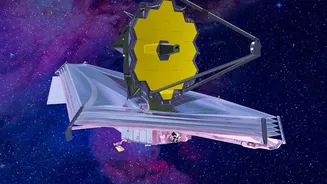
expanding shell of gas shed by a star like our own sun as it runs out of fuel. For years, images from telescopes like Hubble have shown it as a ghostly, glowing donut. But Webb, with its powerful infrared vision, cuts through the dust and gas to reveal the intricate physics of stellar death in breathtaking detail, turning a familiar snapshot into a dynamic story. These new observations provide a level of detail that was previously impossible, offering a fresh look at a fan-favorite.
Inside the Cosmic 'Doughnut'
Previous observations hinted that the nebula was more of a distorted doughnut than a simple ring. Webb’s new images confirm this structure, showing a main ring of gas ejected by the central star, glowing with the light of different chemical elements. But the real revelations are in the details. The telescope’s Near-InfraRed Camera (NIRCam) exposes the complex, filament-like structure within the hot gas of the inner ring. Meanwhile, its Mid-InfraRed Instrument (MIRI) pierces the outer halo, revealing roughly ten concentric arcs. Scientists believe these arcs are formed by the interaction between the central star and a previously unseen companion star, orbiting at a vast distance. These features provide a kind of astronomical archeology, allowing us to trace the star's final, sputtering phases.
Solving a Stellar Mystery
One of the long-standing questions about planetary nebulae is how a single, spherical star can create such complex and beautiful non-spherical structures. Webb’s data strongly suggests that a companion star is the missing piece of the puzzle. The gravitational pull of this smaller, orbiting star likely stirred and shaped the material being ejected by the dying primary star, preventing it from simply expanding in a uniform ball. The faint, concentric arcs in the outer regions are essentially ripples in space, marking periodic ejections of material that were influenced by this orbital dance. Furthermore, Webb’s view shows about 20,000 dense globules rich in molecular hydrogen within the nebula, structures that were largely hidden before. Understanding how these intricate features formed helps explain the chaotic final chapters of a sun-like star’s life.
A Glimpse of Our Solar System's Future
Studying the Ring Nebula isn't just about understanding a distant object; it's also a preview of our own solar system's eventual fate. In about five billion years, our sun will exhaust its nuclear fuel, expand into a red giant, and eventually cast off its outer layers to form its own planetary nebula. The material shed by the Ring Nebula’s star, rich in carbon and other elements forged in its core, will drift into interstellar space. Over millions of years, this dust and gas will mix with the interstellar medium, providing the raw materials for the next generation of stars and planets. By observing this process with the unparalleled clarity of the Webb telescope, scientists are gathering crucial clues about the life cycle of stars and the cosmic recycling program that makes future worlds possible.