



Prepare for Your Cosmic Tour
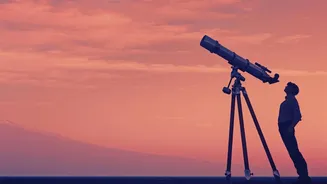
Your most important tool for stargazing is patience. Before you even look up, give your eyes at least 20 to 30 minutes to adjust to the darkness. Avoid looking at your phone or other bright lights, as a single flash can ruin your night vision. If you need
a light, use a red-filtered flashlight. For equipment, you don't need an expensive telescope. A good pair of binoculars, such as a 7x50 or 10x50 set, is powerful enough to reveal both of our targets. If you can, brace your binoculars against a stable surface like a wall or tripod to keep the view steady. Finally, a stargazing app on your phone can act as your real-time map to the cosmos, helping you locate constellations and planets.
Finding Jupiter and its Dancing Moons
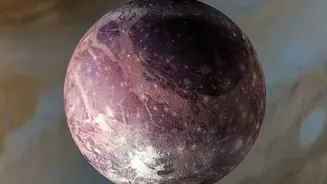
Jupiter is one of the brightest objects in the night sky, outshining every star. This makes it relatively easy to spot, even from light-polluted suburban areas. In September 2026, Jupiter is a brilliant fixture in the early morning sky, rising in the east before dawn. Once you have the planet in your sights, the real show begins. Point your binoculars at the dazzling point of light. Held steady, they will transform that single point into a small, bright disc. Flanking the planet, you should see up to four tiny pinpricks of light arranged in a nearly straight line. These are the Galilean moons: Io, Europa, Ganymede, and Callisto, which Galileo first observed in 1610. Depending on the night, you might see all four, or some may be hidden as they pass in front of or behind Jupiter. Their positions change from night to night, offering a dynamic view of our solar system in motion.
Hunting for the Andromeda Galaxy
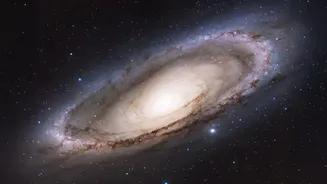
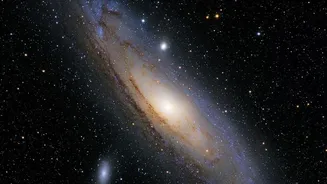
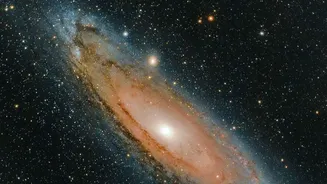
Our second target is the Andromeda Galaxy, also known as M31. It is the most distant object you can see with your naked eye, located about 2.5 million light-years away. Autumn is the best time to view it from the Northern Hemisphere, as it will be high overhead. Unlike bright Jupiter, finding Andromeda requires a bit more technique, especially from a backyard. First, find a spot with the least amount of direct light pollution. The best way to locate Andromeda is a method called star-hopping. Look for the W-shaped constellation Cassiopeia. The right-hand 'V' of the 'W' acts as an arrow that points roughly in the direction of the galaxy. Under dark skies, it appears as a faint, fuzzy smudge of light to the naked eye. Through binoculars, this smudge resolves into a more distinct oval-shaped cloud. That faint patch of light is an entire galaxy, estimated to contain one trillion stars.
What to Expect and Pro Tips
When you look for Andromeda, don't expect the crisp, colorful images you see from space telescopes. To your eye, it will be a faint, greyish blur. The magic isn't in the detail but in the understanding of what you are seeing: another galaxy far beyond our own. To improve your view of such faint objects, use a technique called averted vision. Instead of staring directly at the spot where the galaxy should be, look slightly to the side. This uses the more light-sensitive parts of your eye, often making the faint object pop into view. For Jupiter, the reward is more immediate. The planet itself is a brilliant sight, and seeing its moons shift their positions over a few nights is a powerful reminder of the celestial mechanics at play. The best time to observe is during the new moon phase, when the sky is darkest.