


The Universe's Murky Beginnings
Imagine trying to look through a dense fog that blankets everything. That's a good picture of the early universe. For a period lasting roughly from 400,000 to one billion years after the Big Bang, the cosmos was filled with a thick haze of neutral hydrogen
gas. This era, often called the 'cosmic dark ages,' was opaque to the most energetic forms of light, like ultraviolet (UV) radiation. Before this fog could lift, something had to fundamentally change the nature of the universe. Astronomers have long theorized that the very first stars and galaxies were the culprits. As they ignited, their intense radiation would have started to 'ionize' the surrounding gas, stripping electrons from the hydrogen atoms. This process, known as the Epoch of Reionization, wasn't instantaneous. It likely happened in patches, with bubbles of transparent, ionized gas growing around the first galaxies and eventually overlapping until the entire universe became the clear, star-filled vista we can see today. The big question has always been: which galaxies did the heavy lifting, and how?
An 'Impossible' Glimpse of Ultraviolet Light
In a recent breakthrough, a team of astronomers using NASA's Hubble Space Telescope found a critical clue. They detected powerful, ionizing UV light escaping from a galaxy named MXDFz4.4, which existed about 1.4 billion years after the Big Bang, right at the tail end of the reionization era. This was a surprise, as many researchers believed the remaining cosmic fog would be too thick to allow such a direct view. "Observing a galaxy like this was thought to be impossible," said Ilias Goovaerts, the lead author of the study from the Space Telescope Science Institute. The discovery was made by combining extremely deep Hubble images with data from the James Webb Space Telescope (JWST) and the European Southern Observatory's Very Large Telescope (VLT). This collaboration allowed the team not only to spot the faint UV glow but also to understand the properties of the galaxy producing it. It turns out, MXDFz4.4 is a powerhouse in a small package.
A Small Galaxy with a Big Impact
While MXDFz4.4 is about 100 times smaller than our own Milky Way galaxy, it's forming stars at a rate roughly ten times faster. These aren't just any stars; they are young, massive, and incredibly hot, all crammed into a very compact space. This intense concentration of stellar firepower is what allows the galaxy to punch above its weight. The combined energy blasts through the gas within the galaxy itself, creating channels for the ionizing UV light to escape into the intergalactic medium. This finding provides the first direct evidence of how a small, starburst galaxy could be so effective at clearing its surroundings. The observation helps confirm the long-held theory that numerous small but mighty galaxies, rather than just a few large ones, were the primary engines behind lifting the cosmic fog and making the universe transparent.
Connecting Hubble's Past to Webb's Future
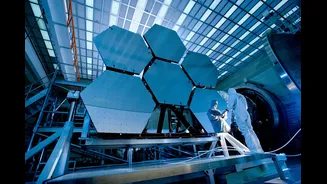
The discovery of MXDFz4.4 showcases the remarkable synergy between old and new astronomical tools. The initial find came from re-examining archival deep-field images taken by Hubble over many hours of observation. But to fully understand the galaxy's distance, mass, and star-forming history, researchers relied on the infrared capabilities of the newer James Webb Space Telescope. While Hubble gave us this unprecedented peek at the end of reionization, JWST is designed to push even further back in time, into the heart of the cosmic dawn itself. Recent Webb observations have already identified galaxies from just 330 million years after the Big Bang, showing that the process of clearing the fog may have started even earlier than previously thought. Each new discovery, whether from Hubble's decades of data or Webb's cutting-edge instruments, adds a vital piece to the puzzle of our cosmic origins.