


First, Is This Really True?
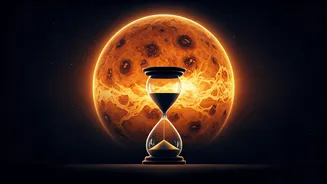
Yes, the headline is completely true, and it’s one of the strangest facts about our solar system. A year on Venus—the time it takes to complete one orbit around the Sun—is approximately 225 Earth days. However, a day on Venus—the time it takes for the planet
to complete one single rotation on its axis—is about 243 Earth days. So, if you were standing on Venus, the planet would finish its trip around the Sun before it even finished spinning around once. It’s a mind-bending concept that turns our Earth-based understanding of time on its head. This 'day' of 243 Earth days is what astronomers call a sidereal day. Confusingly, the time from one sunrise to the next, known as a solar day, is much shorter, but still an incredibly long 117 Earth days. Both measures reveal a planet that behaves unlike any other in our cosmic neighbourhood.
The Secret Lies in the Spin
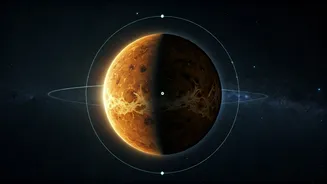
The primary reason for this temporal weirdness is Venus's extraordinarily slow and backward rotation. Most planets in our solar system, including Earth, spin on their axis in a counter-clockwise direction (prograde motion). Venus is the odd one out, spinning clockwise in what is known as retrograde rotation. Only Uranus, which is tilted on its side, has a similarly strange spin. Not only is Venus’s spin backward, but it is also agonisingly slow. While Earth whips around on its axis once every 24 hours, Venus takes 243 Earth days to do the same. This sluggish, backward waltz is the key ingredient that makes its day longer than its year. If it spun faster, or in the same direction as Earth, its day-year relationship would be much more 'normal'.
An Atmosphere That Crushes and Brakes
So, why does Venus spin this way? For a long time, scientists were stumped, but modern research points to a powerful culprit: its atmosphere. The Venusian atmosphere is a runaway greenhouse effect nightmare. It’s about 96% carbon dioxide and so dense that the pressure on the planet's surface is over 90 times that of Earth's—equivalent to being a kilometre deep in our ocean. This thick, heavy blanket of gas doesn't just sit there. It whips around the planet at high speeds, creating what is known as a 'super-rotation'. According to studies from space agencies like NASA, this powerful atmosphere exerts a massive amount of friction on the planet's surface. Over billions of years, this atmospheric drag has likely acted as a giant brake, slowing Venus’s original rotation to its current crawl and helping to maintain its retrograde spin against the Sun’s gravitational pull.
The Ghost of a Violent Past
The atmosphere might explain how the slow spin is maintained, but it might not be the original cause. Another compelling theory suggests a more violent origin story. In the chaotic early days of the solar system, when planet-sized objects were constantly crashing into each other, Venus may have been struck by a massive asteroid or protoplanet. A sufficiently powerful collision, or perhaps a series of them, could have been catastrophic enough to not just slow its rotation but completely reverse it, sending it into its backward spin. This impact hypothesis is a popular explanation for many planetary oddities, including the formation of Earth's Moon and the extreme tilt of Uranus. For Venus, a brutal cosmic smash-up could have set it on a completely different evolutionary path from Earth, turning our 'sister planet' into a strange, slow-spinning twin.
What a Venusian Day 'Feels' Like
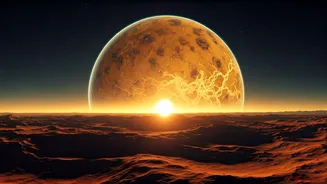
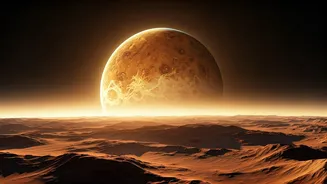
Let's put this all together. If you could survive the crushing pressure and furnace-like heat (around 465°C), what would a day on Venus be like? Due to the combination of its slow spin and its orbit, the Sun would rise in the west and set in the east. You would experience daylight for nearly two Earth months, followed by an equally long night. The sky would be a perpetual, hazy yellow-orange from the thick sulfuric acid clouds, and you'd have to wait 117 Earth days to see the Sun rise again. It’s a stark reminder of how diverse and extreme planetary environments can be, even on a planet so similar to Earth in size and composition.