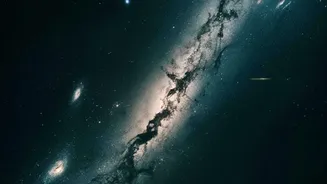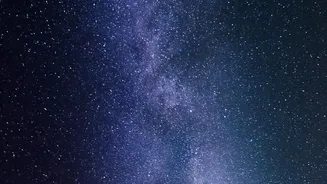




On a clear night, far from city lights, the sky reveals a breathtaking sight: a faint, luminous band stretching across the heavens. This is the Milky Way, our home galaxy. But why does it appear as a flat ribbon of light?
Our Galactic Home Address
First, it helps to understand
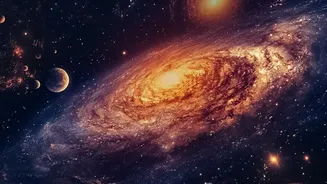
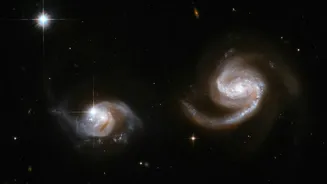
what the Milky Way actually is. It’s a massive, ancient city of stars, a barred spiral galaxy estimated to be about 13.6 billion years old. It contains somewhere between 100 and 400 billion stars, along with vast clouds of gas and dust. The main structure is a gigantic, flat disc of stars, roughly 100,000 light-years across but only about 1,000 light-years thick. At its heart is a dense central bulge and a supermassive black hole known as Sagittarius A*.
A View From the Inside
The reason the Milky Way looks like a band is all about perspective. Imagine you're inside a massive, flat chapati. If you look up or down, you see very little of the chapati itself. But if you look towards its edge, you see its entire thickness stretching out before you. Our solar system is in a similar situation. We are embedded within the flat disk of the galaxy, in a minor spiral arm called the Orion Arm (or Orion Spur), about 27,000 light-years from the galactic centre. When we look up into the night sky, we are looking out from inside this disk. Gazing in directions perpendicular to the disk's plane, we see fewer stars. But when we look along the plane of the disk, we are peering into its dense, star-filled expanse. The light from billions of distant, unresolved stars merges together, creating that beautiful, milky band.
Cosmic Dust and Dark Rivers
If you get an exceptionally clear view, you’ll notice that the band isn’t uniform. It's mottled with dark patches and long, dark lanes that seem to be voids where no stars exist. For a long time, astronomers thought these were 'holes in the heavens'. We now know these are not empty spaces at all. Instead, they are vast, dense clouds of interstellar dust and gas that block the light from the more distant stars behind them. This creates a silhouette effect. The most prominent of these features is called the Great Rift, a dark band that appears to split the brightest part of the Milky Way. Ironically, these dark, obscuring clouds are not voids but stellar nurseries, the very places where new stars and planets are being born, hidden from our view in visible light.
Putting It All Together
So, the appearance of the Milky Way is a combination of three key factors. First, the galaxy has a flat, disk-like structure where most stars are concentrated. Second, our solar system is located within this disk, giving us an edge-on view. Finally, immense clouds of dust also located in the disk obscure parts of it, creating the dark rifts that add to its complex beauty. All the individual stars you can see with the naked eye are our relatively close neighbours within the galaxy. That luminous band, however, is the combined glow of billions of stars farther away, all located in the galaxy’s sprawling, flat plane.