



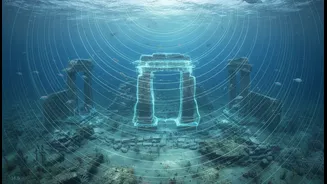


A Glimpse Beneath the Waves
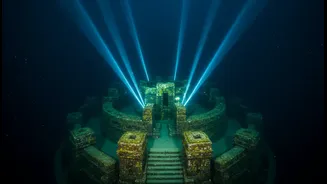
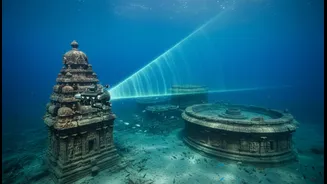
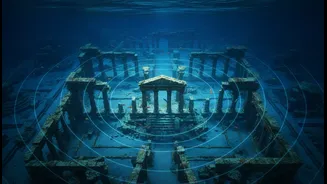
Beneath the waters of the Bay of Bengal, a team of scientists and researchers has uncovered compelling evidence of submerged structures, potentially belonging to a long-lost settlement. Expeditions, particularly off the coast of Poompuhar and Mahabalipuram,
have used advanced technology to peer through the ocean's depths, revealing features that suggest human activity from centuries, or even millennia, ago. Institutions like the National Institute of Ocean Technology (NIOT) and the Tamil Nadu State Department of Archaeology have been at the forefront of these explorations. Their findings include what appear to be walls, scattered stone blocks, remnants of buildings, and other formations that do not seem to be the result of natural geological processes. These discoveries were often prompted by anecdotal evidence, such as sightings of structures by locals during the 2004 tsunami when the sea temporarily receded.
Painting with Sound
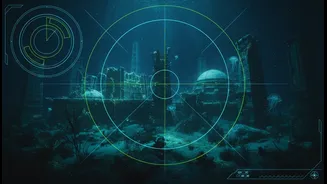
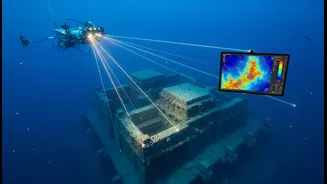
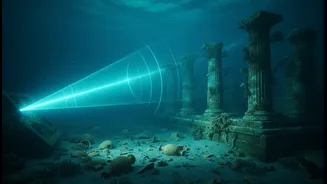
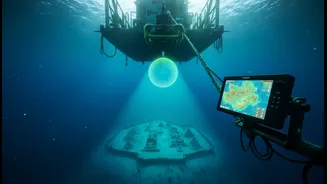
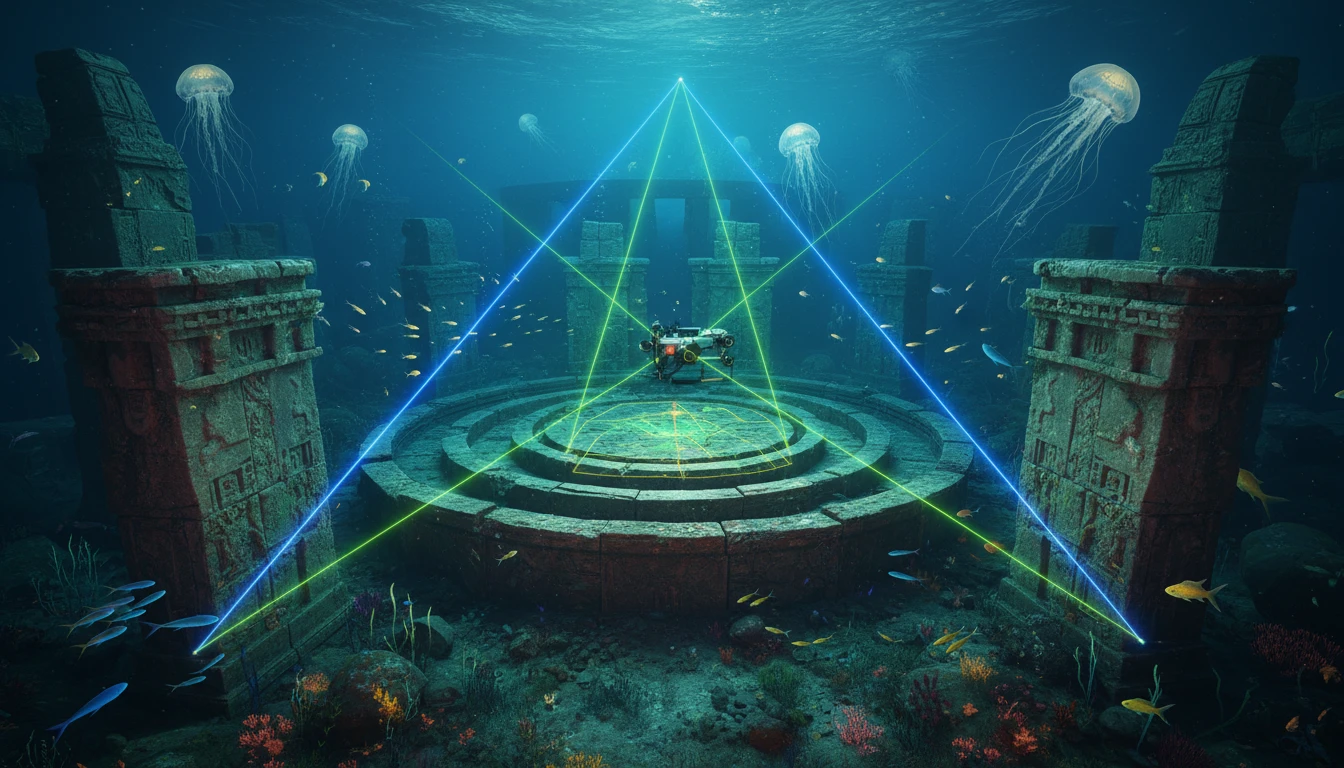
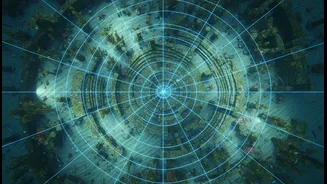
The key to these discoveries lies in a technology called side-scan sonar. Unlike regular sonar which just measures depth, side-scan sonar sends out fan-shaped acoustic pulses to paint a detailed picture of the seafloor's texture and contours. A vessel carrying the sonar equipment moves over the survey area, and the returning sound waves are pieced together by a computer to create a high-resolution, almost photographic image of what lies below. This method is indispensable for marine archaeology because it can cover vast areas quickly and effectively, regardless of water clarity. For the Tamil Nadu explorations, research vessels from NIOT were equipped with not only side-scan sonar but also multibeam echosounders and sub-bottom profilers, which can even detect objects buried under sediment. This technological toolkit allows experts to identify anomalies on the seabed that warrant closer inspection.
Man-Made or Natural?
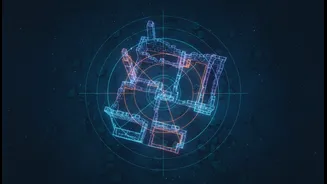
The sonar maps have revealed intriguing shapes, including U-shaped and horse-shoe-shaped objects, long walls, and grid-like patterns that suggest a planned settlement. One of the most talked-about sites is off the coast of Poompuhar, an ancient port city celebrated in Sangam literature. Surveys there have identified structures spread over a large area, some located miles offshore at depths of 23 meters or more. In some cases, divers have been sent down to verify the sonar data, finding stone blocks and wall-like formations, though often covered in thick marine growth. While some geologists argue that such formations could occur naturally, many archaeologists who have reviewed the data believe the regular, geometric patterns are strong evidence of man-made construction. The debate is ongoing, as definitive proof requires physical samples and extensive underwater excavation, a challenging and expensive task.
Echoes of a Lost Land?
These underwater discoveries inevitably bring to mind the ancient Tamil legends of lost lands, most famously the continent of Kumari Kandam. According to literary traditions, a great portion of land south of today's India, ruled by the Pandyan kings, was swallowed by the sea in a catastrophic event. While the idea of a sunken continent is not supported by modern geology, the legends of 'kadal kol' (the sea taking the land) may be a cultural memory of very real events. The end of the last Ice Age saw significant sea-level rise globally, which would have submerged coastal settlements. The structures found off Poompuhar and Mahabalipuram might be the physical remnants of the very cities and ports mentioned in ancient texts—not a lost continent, but a lost coastline, its memory preserved for thousands of years through myth and poetry.
The Next Voyage
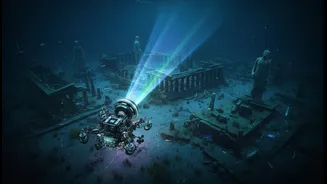
Mapping is only the first step. The data collected by the sonar experts has provided a treasure map for future archaeological work. The next phase involves more detailed investigation using Remotely Operated Vehicles (ROVs), which can capture high-definition video and images of the structures. Ultimately, marine archaeologists will need to conduct careful underwater excavations, collecting artefacts and samples that can be dated using modern scientific techniques. These efforts are part of a larger push, supported by initiatives like India's Deep Ocean Mission, to explore and understand the nation's vast underwater heritage. The establishment of new centres for marine robotics at NIOT further signals a commitment to developing the indigenous technology needed for these complex deep-sea explorations.