




A New Polygon on the Ringed Planet
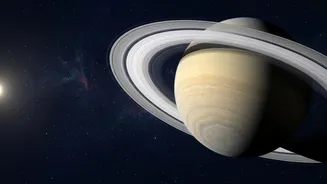
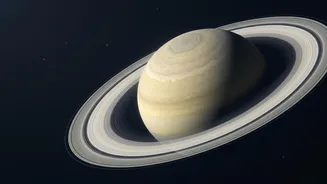
Just when we thought we knew Saturn’s greatest atmospheric tricks, the planet reveals another. In a major discovery announced in early September 2026, astronomers have confirmed the existence of a massive, 10-sided atmospheric wave—a decagon—swirling
around the planet’s south pole. The finding was made by analysing years of observations from the Hubble Space Telescope, captured as part of its Outer Planet Atmospheres Legacy (OPAL) program. While the pattern became distinct in recent images, researchers traced its faint origins back to images taken in 2023, watching it strengthen over time. This marks the first time such a large, regular-sided jet pattern has been seen in Saturn's southern hemisphere, offering a rare chance to witness the birth of a planetary-scale weather phenomenon.
The Decagon vs. The Famous Hexagon
For decades, Saturn's most baffling atmospheric feature has been the persistent hexagon at its north pole, a six-sided jet stream wider than two Earths. Discovered by the Voyager mission in the 1980s, the hexagon has remained remarkably stable. The new decagon is both similar and strikingly different. While both are colossal weather patterns locked into jet streams, the decagon is a southern-hemisphere feature with ten sides, not six. Furthermore, the hexagon has been a fixture for over 40 years, while the decagon appears to be a recent formation. The Cassini spacecraft, which orbited Saturn from 2004 to 2017, saw no evidence of a stable polygon at the south pole, making the decagon’s sudden appearance a genuine scientific puzzle.
The Science of Planetary Polygons
How can a planet's atmosphere create such perfect-looking geometric shapes? These are not solid structures but standing waves in powerful jet streams, moving at hundreds of kilometres per hour. The shape is believed to arise from instabilities in the flow, where a fast-moving jet stream interacts with slower atmospheric layers, causing it to meander into a stable, polygonal pattern. Scientists have even replicated similar shapes in laboratory experiments using rotating tanks of liquid. The fact that one pole formed a hexagon and the other a decagon suggests subtle but important differences in the atmospheric conditions and wind structures between Saturn's north and south. The number of sides a wave settles into is linked to the jet's specific speed and width, making these shapes a visible fingerprint of the planet's deep atmospheric dynamics.
A Mystery Unfolding in Real Time
The discovery has energised the planetary science community because it offers an unprecedented opportunity to study the evolution of a massive atmospheric structure from its early stages. “The northern hexagon has been there every time we've looked for more than 40 years,” noted Amy Simon, a principal investigator for the OPAL program. “This feature is different—it appears to be strengthening, giving us the rare opportunity to watch a giant atmospheric pattern develop.” Researchers are now working to understand the trigger for its formation. Some speculate it may be linked to a nearby high-pressure vortex that appeared around the same time, possibly providing the initial disturbance that kicked off the wave's formation.