






The Brains Behind the Drive: Advanced Autonomy
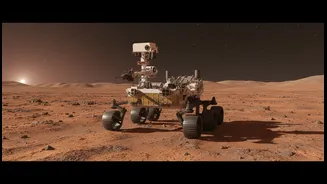
Perseverance can’t be remote-controlled like a toy car. The communication delay between Earth and Mars can be up to 20 minutes each way, making real-time driving impossible. To overcome this, the rover relies on a sophisticated autonomous navigation system
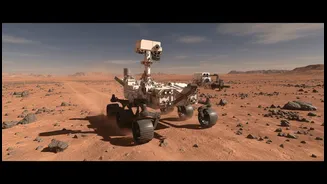
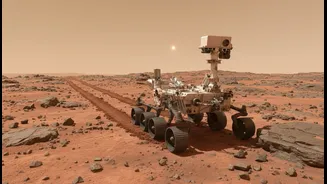
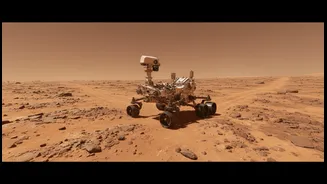
called AutoNav. This system allows Perseverance to “think while driving.” Using its stereo navigation cameras, it creates a 3D map of the terrain ahead, identifies potential hazards like sharp rocks or steep slopes, and plots the safest and most efficient path forward, all without direct input from engineers on Earth. This is a significant upgrade from previous rovers like Curiosity, as Perseverance can analyze the terrain and make decisions while its wheels are still turning, rather than having to stop, process, and then move. This enhanced capability allows it to cover more ground, break driving records, and reach scientifically interesting locations much faster.
Powering the Long Haul: A Nuclear Battery
To survive the frigid Martian nights and power its suite of scientific instruments, Perseverance doesn't rely on solar panels, which can be covered by dust and are useless in the dark. Instead, it’s powered by a Multi-Mission Radioisotope Thermoelectric Generator (MMRTG). This device is essentially a nuclear battery. It uses the heat generated from the natural decay of 4.8 kilograms of plutonium-238 to produce a steady supply of about 110 watts of electricity. This reliable power source ensures the rover can operate day and night, through dust storms, and during the harsh Martian winter. The excess heat from the MMRTG is also cleverly used to keep the rover's sensitive electronics and systems warm. The MMRTG is designed to last for at least 14 years, giving Perseverance plenty of energy for its extended mission.
Staying Healthy Millions of Miles from Home
On Mars, there are no mechanics. Perseverance was built for endurance and largely operates until a component fails. However, it is equipped with extensive self-monitoring capabilities. The rover's main computers constantly check its vital signs, such as temperature and power levels, to ensure all systems are functioning correctly. It can automatically adjust its thermal controls to avoid getting too hot or too cold. Its cameras are not just for science and navigation; they are also used for engineering health checkups, allowing teams on Earth to visually inspect parts of the rover for wear and tear. For example, engineers learned from the Curiosity mission and designed Perseverance’s wheels to be more robust, with thicker aluminum and a different tread pattern to better withstand sharp rocks. While the rover can't repair itself, this constant health monitoring helps engineers on Earth make informed decisions to prolong its operational life.
Built to Last: The Challenge of Mobility
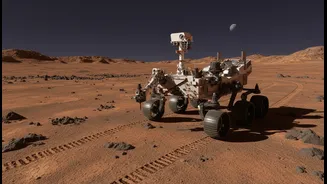
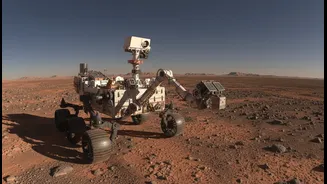
Covering the distance of a marathon on Mars is a remarkable feat of mobility engineering. Perseverance is equipped with six durable aluminum wheels, each with its own motor for power and a sophisticated suspension system known as a "rocker-bogie." This suspension allows the rover to keep all six wheels on the ground when climbing over obstacles as large as its own wheels (about 20.7 inches in diameter) and helps keep the rover body stable. The wheels themselves are an evolution from Curiosity's, designed to be thicker and more durable. They feature 48 cleats, or grousers, for traction in soft sand and on hard rocks, with curved titanium spokes for springy support. With a top speed of just under 0.1 mph, the goal isn't speed but endurance and safety across a landscape that could easily end the mission.