



A Cosmic Nursery in a New Light
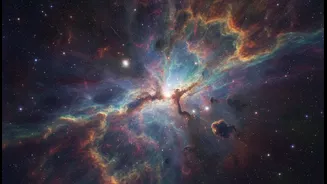
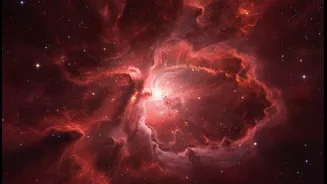
Astronomers are gazing in awe at breathtaking new vistas captured by the James Webb Space Telescope (JWST). One of the most stunning is a fresh portrait of the Serpens Nebula, a stellar nursery located approximately 1,300 light-years from Earth. While
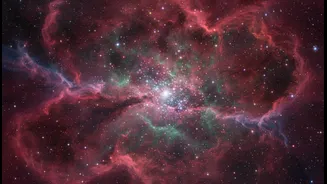
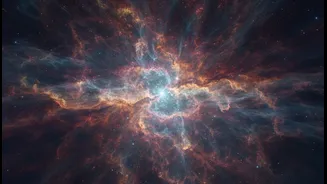
star-forming regions have been imaged before, Webb’s powerful infrared vision cuts through the dense curtains of cosmic dust that have historically hidden the action. What it has revealed are dramatic, vibrant structures previously invisible to telescopes that see in visible light. The image is a celestial canvas of wispy orange and blue gas, but the most scientifically exciting features are the fiery crimson streaks that slash across the top left corner. These are not just beautiful flourishes; they are direct evidence of brand-new stars violently announcing their arrival.
Decoding the Crimson Clues
So, what are these crimson features? In the colour-coded language of astronomy, this red hue represents the glow of excited molecules, primarily molecular hydrogen and carbon monoxide. These molecules light up when they are hit by powerful shockwaves. The source of these shockwaves are colossal jets of material being blasted out from the poles of protostars—infant stars that are still in the process of gathering mass from a surrounding disk of gas and dust. As these baby stars spin, their magnetic fields act like cosmic slingshots, flinging material away at incredible speeds. When this high-velocity jet ploughs into the colder, ambient gas of the nebula, it creates a glowing shock front, which Webb renders as a clumpy, crimson streak. Seeing these jets tells astronomers that a star is actively being born.
The Engines of Creation
These jets are more than just cosmic fireworks; they are a fundamental part of how stars and solar systems come to be. The process of star formation is a delicate balance between gravity pulling material in and these powerful outflows pushing material out. The jets act as a release valve, carrying away excess angular momentum from the spinning protostar and its disk. Without this mechanism, the young star would spin itself into oblivion before it could accumulate enough mass to ignite nuclear fusion. In the Serpens Nebula image, what is particularly remarkable is that many of these crimson jets are aligned in the same direction, like sleet in a storm. Astronomers believe this suggests the stars all formed from the same large, rotating cloud of gas, inheriting its original spin—a historical record of the fundamental way stars are born.
Webb's Unrivaled Vision
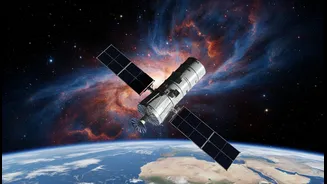
Capturing these details would be impossible without the specific capabilities of the James Webb Space Telescope. Star-forming regions are notoriously dusty, and that dust acts like an impenetrable fog to telescopes like Hubble, which primarily see in visible light. Webb, however, is designed to see the universe in infrared light. This longer wavelength of light can pass through the thick dust clouds, allowing astronomers to peer into the heart of these stellar nurseries for the first time. The telescope's Near-InfraRed Camera (NIRCam) is perfectly suited to detect the faint glow from shocked molecular hydrogen, making it the ideal instrument to map these crucial outflows and reveal the hidden mechanics of star birth in unprecedented detail.
Rewriting the Story of Stars
These new observations are providing a treasure trove of data that is refining our understanding of astrophysics. By studying the composition and structure of these jets, scientists can learn about the chemical environment in which stars—and their future planets—form. Some of the key questions being investigated are how much of the raw material from the parent cloud ends up in the star versus its planetary disk, and how these violent outflows influence the subsequent generations of stars that may form nearby. Each new image from Webb, with its stunning colours and incredible resolution, moves us closer to answering some of the oldest questions we have: where do stars come from, and how do planetary systems like our own begin their journey? The crimson jets of the Serpens Nebula are a vivid reminder that the universe is a dynamic, evolving place, still actively forging new worlds.