





A Personal Spaceship, Not a Garment
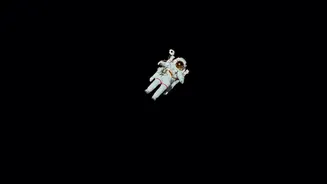
The first thing to understand about a modern spacesuit, like those used for spacewalks outside the International Space Station or planned for Artemis missions to the Moon, is that it functions as a self-contained spacecraft shaped like a human. Its primary
job is to create a tiny, artificial environment that mimics the conditions on Earth. Without it, an astronaut would face a near-instant threat from the vacuum of space, extreme temperature swings, radiation, and even tiny, high-speed particles of dust. Every layer and system is engineered to counteract these dangers, turning the suit into the ultimate survival gear.
Maintaining Life-Sustaining Pressure
Space is a vacuum, with almost no atmospheric pressure. On Earth, the air around us constantly pushes on our bodies, and our bodies push back. Without this external pressure, the fluids in an astronaut's body would boil, a catastrophic event called ebullism. To prevent this, a spacesuit contains a bladder layer, which is like a strong, human-shaped balloon. This layer is filled with pure oxygen to a pressure of about 4.3 pounds per square inch (psi). While much lower than Earth's 14.7 psi, this pure oxygen environment is enough to keep body fluids stable and provide breathable air without making the suit too rigid to move in. A tough restraint layer on top of the bladder prevents it from ballooning outward.
A Breathable Atmosphere on the Go
The astronaut's life-support functions are managed by a backpack, officially known as the Primary Life Support System (PLSS). This unit holds tanks of pure oxygen for breathing. A fan circulates the oxygen from the backpack into the helmet, flowing down over the astronaut's face to ensure they breathe the freshest supply. As the astronaut exhales carbon dioxide, this toxic gas must be removed. The PLSS draws the exhaled air through canisters containing materials like lithium hydroxide or a newer, reusable metal-oxide (Metox) system, which scrubs the CO2 from the air before it's recirculated. The PLSS also contains batteries for power and a two-way radio for communication.
Surviving Extreme Temperatures
In space, temperatures can swing wildly, from over 120°C in direct sunlight to below -150°C in the shade. To manage this, astronauts first put on a Liquid Cooling and Ventilation Garment (LCVG). This is a full-body undergarment, similar to long underwear, made of spandex and woven with about 300 feet of thin plastic tubing. Chilled water is continuously pumped through these tubes from the PLSS, absorbing the astronaut's body heat and any external heat that penetrates the suit. The warmed water returns to the PLSS, where a device called a sublimator exposes some of the water to the vacuum of space, causing it to instantly freeze and then turn to vapour, carrying excess heat away with it.
A Shield Against the Void
The outermost part of the suit, known as the Thermal Micrometeoroid Garment (TMG), is a multi-layered shield. It can have up to 16 layers, made from a variety of advanced materials including Dacron, Mylar, Neoprene, Kevlar, and Gore-Tex. Several layers of aluminized Mylar, much like a thermos, provide thermal insulation to protect against temperature swings. The outer layers are made of tough, rip-resistant, and non-flammable fabrics like a blend of Gore-Tex, Kevlar, and Nomex to protect against micrometeoroids — tiny particles of rock or debris traveling at thousands of miles per hour that could otherwise puncture the suit. The helmet's visor has a thin gold coating to reflect harmful solar radiation, acting as a powerful pair of sunglasses.