



A Steamy Atmosphere, 1,150 Light-Years Away
The planet in question is WASP-96 b, a gas giant located roughly 1,150 light-years from Earth. It's not a candidate for life as we know it; this 'hot, puffy' world is about half the mass of Jupiter but orbits its star in a blistering 3.4 days. While previous
observations by telescopes like Hubble have detected water on exoplanets before, the data from JWST is the most detailed of its kind to date. The powerful new view not only confirms the presence of water but also provides evidence for clouds and haze, elements that previous studies of this planet failed to detect.
The Technology Behind the Discovery
So, how did scientists find water on a planet over a thousand light-years away? The answer lies in a technique called transmission spectroscopy. As WASP-96 b passed in front of its host star, the JWST’s Near-Infrared Imager and Slitless Spectrograph (NIRISS) instrument analysed the starlight that filtered through the planet’s atmosphere. Different molecules absorb specific colours, or wavelengths, of light. Water molecules leave a unique and identifiable 'signature' in the light's spectrum. By capturing these tiny dips in brightness across a range of infrared colours, JWST essentially 'read' the chemical makeup of the planet's sky, revealing a clear and robust signal of water vapour.
More Than Just Water
The term 'layers' in the context of this discovery refers to the unprecedented detail in the data. The spectrum allows scientists to do more than just say 'water exists'. They can now begin to measure the amount of water vapour, constrain the abundance of other elements like carbon and oxygen, and even estimate the temperature of the atmosphere at different depths. This is akin to moving from seeing a blurry, single-colour image of a planet to a high-resolution, multi-layered profile. This depth of information gives clues about the planet’s overall makeup and provides insights into how, when, and where it may have formed.
A Return on a Monumental Investment
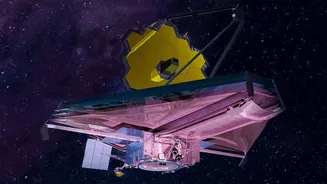
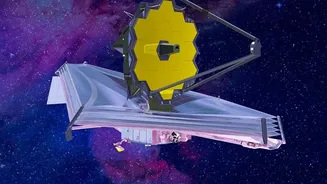
The James Webb Space Telescope is a multi-billion dollar international collaboration, and findings like this demonstrate its immense value. This isn't just a scientific win; it's a technological triumph. The telescope's massive mirror and highly sensitive instruments are performing beyond expectations, providing data that is already rewriting our understanding of planetary science. The ability to dissect the atmosphere of a world so far away proves the technology's power and potential. It signals that the JWST is fully equipped to conduct the wide range of exoplanet investigations that the scientific community has been planning for decades.
A Stepping Stone to Finding Habitable Worlds
While WASP-96 b is far from habitable, this discovery is a crucial stepping stone. The same techniques used here will be applied to smaller, rocky, Earth-sized planets, including those in the famous TRAPPIST-1 system. The ability to detect water is just the beginning. Webb's instruments are also sensitive to molecules like methane and carbon dioxide, which can be potential biosignatures—indicators of life. By proving its ability to parse the atmosphere of a gas giant with such precision, JWST has shown it has the tools to eventually search for the ingredients of life on Earth-like worlds, inching us closer to answering the ultimate question: are we alone?