



An Ocean World Warmed by Gravity
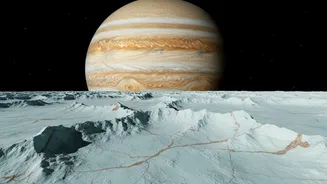
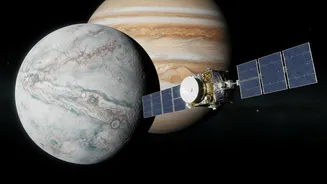
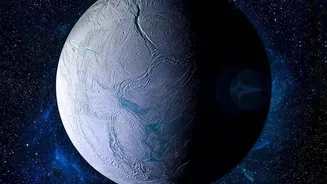
Slightly smaller than Earth’s moon, Europa is a world sculpted from rock and water ice. It orbits Jupiter in a path that causes it to be constantly squeezed and stretched by the gas giant's immense gravity. This process, known as tidal flexing, generates
enough internal friction and heat to keep the ocean beneath its frozen surface liquid. Data from past missions like Galileo strongly suggest this ocean is not just vast—potentially containing twice the water of all of Earth's oceans combined—but also salty. This hidden sea, in contact with a rocky seafloor, creates a scenario that astrobiologists find incredibly exciting.
Meet the Robotic Explorer
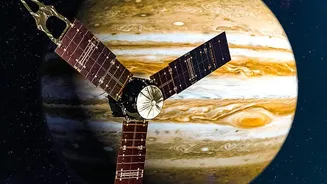
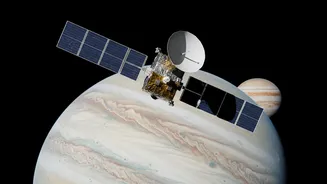
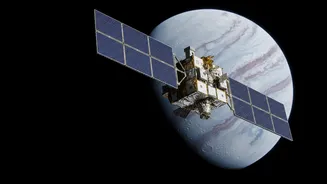
Enter the Europa Clipper, the largest interplanetary spacecraft NASA has ever built, which launched in October 2024. Its primary goal is not to find life directly, but to determine if Europa has all the necessary ingredients for it. After arriving in the Jupiter system in 2030, Clipper won't orbit Europa itself due to the planet's intense radiation. Instead, it will make nearly 50 close, high-speed flybys, soaring as low as 25 kilometers above the surface. This strategy allows its nine advanced science instruments to gather detailed data before retreating to a safer distance to transmit its findings back to Earth.
Following the Water and Ice
One of the mission's top objectives is to confirm the ocean's existence and measure the thickness of the ice shell above it, which is estimated to be anywhere from 3 to 30 kilometers thick. To do this, Clipper is equipped with an ice-penetrating radar instrument called REASON. It will beam radio waves through the ice, searching for the reflection that would bounce off a liquid water ocean below. Another key instrument, a magnetometer, will measure the magnetic field generated by Jupiter's interaction with Europa. The strength of this induced field will help scientists determine the ocean's depth and saltiness, as a saltier ocean is more electrically conductive.
Searching for the Chemistry of Life
Life as we know it requires certain chemical building blocks, often referred to as CHNOPS (carbon, hydrogen, nitrogen, oxygen, phosphorus, and sulfur). Europa Clipper has instruments designed to hunt for these elements. The Hubble Space Telescope has previously detected hints of water vapor plumes erupting from Europa's surface. If these cryogeysers are active, instruments like the MAss Spectrometer (MASPEX) and the SUrface Dust Analyzer (SUDA) could directly sample the ocean's contents without needing to land. By flying through these plumes, the spacecraft could analyze their chemical makeup and identify if the ocean contains the organic molecules necessary for life.
A New Paradigm for Astrobiology
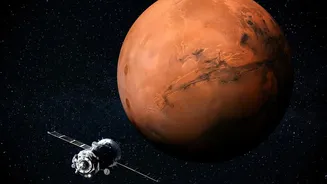
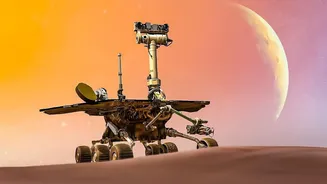
This mission represents a fundamental shift in the search for extraterrestrial life. For years, missions to Mars have focused on finding evidence of past habitability—looking for dried-up riverbeds and ancient biosignatures. Europa Clipper, however, is investigating a potentially active habitable environment. It's the difference between planetary archaeology and investigating a living, breathing world. By focusing on an ocean world warmed by internal heat rather than direct sunlight, the mission also redefines our understanding of a "habitable zone." It suggests that life could exist in the dark, cold outer reaches of a solar system, far from a star's warmth, sustained instead by tidal forces and chemical energy from hydrothermal vents, much like life found in Earth's deep oceans.