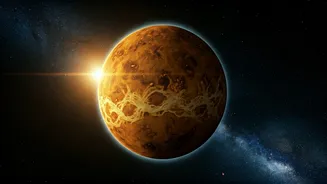





Just How Slow Is Venus?
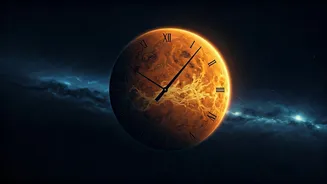
When we say Venus is slow, it’s a cosmic understatement. While Earth completes a rotation on its axis in about 24 hours, Venus takes a staggering 243 Earth days to do the same. This means a single sidereal day on Venus (one full rotation) is the longest
of any planet in our solar system. To put that in perspective, by the time Venus has spun around just once, Earth has experienced more than eight months. This isn't just a quirky fact; it has profound implications for the planet's environment, creating a world of extreme temperatures and crushing atmospheric pressure, completely alien to our own.
A Day Longer Than a Year
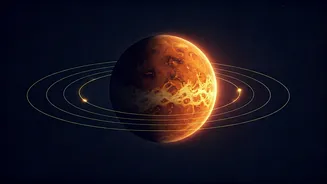
Here is where things get truly mind-bending. Venus takes about 225 Earth days to complete one orbit around the Sun. This is its year. Now, compare that to its rotation period of 243 Earth days. Yes, you read that correctly: a day on Venus is longer than a year on Venus. This celestial paradox makes our concept of time feel utterly terrestrial. Because the planet is spinning so slowly while also orbiting the sun, a solar day on Venus—the time from one sunrise to the next—is actually shorter than its rotational period, clocking in at around 117 Earth days. It’s a confusing calendar, to say the least, and one of the key reasons astronomers find our 'sister planet' so fascinatingly bizarre.
It Also Spins the Wrong Way
As if its snail's pace weren't strange enough, Venus also spins in the opposite direction of most other planets. With the exception of Uranus (which is tilted on its side), all planets in our solar system rotate on their axis in a counter-clockwise direction, a motion known as prograde rotation. Venus, however, spins clockwise. This is called retrograde rotation. If you could stand on the surface of Venus and survive its hostile conditions, you would see the Sun rise in the west and set in the east. This backward spin adds another layer to the planetary mystery, suggesting that something dramatic must have happened in Venus's distant past.
The Leading Theory: A Heavy Atmosphere
So, why is Venus so slow and backward? The leading hypothesis points to its incredibly thick, heavy atmosphere. Venus's atmosphere is about 92 times denser than Earth's and is composed almost entirely of carbon dioxide. This dense blanket of gas is believed to create powerful atmospheric tides, driven by solar heating. Over billions of years, the friction between this heavy, churning atmosphere and the solid planet beneath may have acted as a powerful brake, slowing down Venus's rotation to its current crawl. The same forces could have even been strong enough to eventually reverse its original spin direction, leading to its current retrograde motion.
An Alternative Idea: A Cosmic Collision
Another compelling theory suggests a more violent history. In the chaotic early days of the solar system, when planet-sized objects frequently collided, Venus may have been struck by a massive asteroid or another protoplanet. Such a catastrophic impact could have had enough force to drastically alter its spin, either slowing it down dramatically or even knocking it 'upside down' so that it effectively spins backward. While the atmospheric drag theory is currently more favoured by many scientists, the possibility of a formative cosmic smash-up remains a powerful explanation for Venus's unusual characteristics.
How We Pierced the Veil
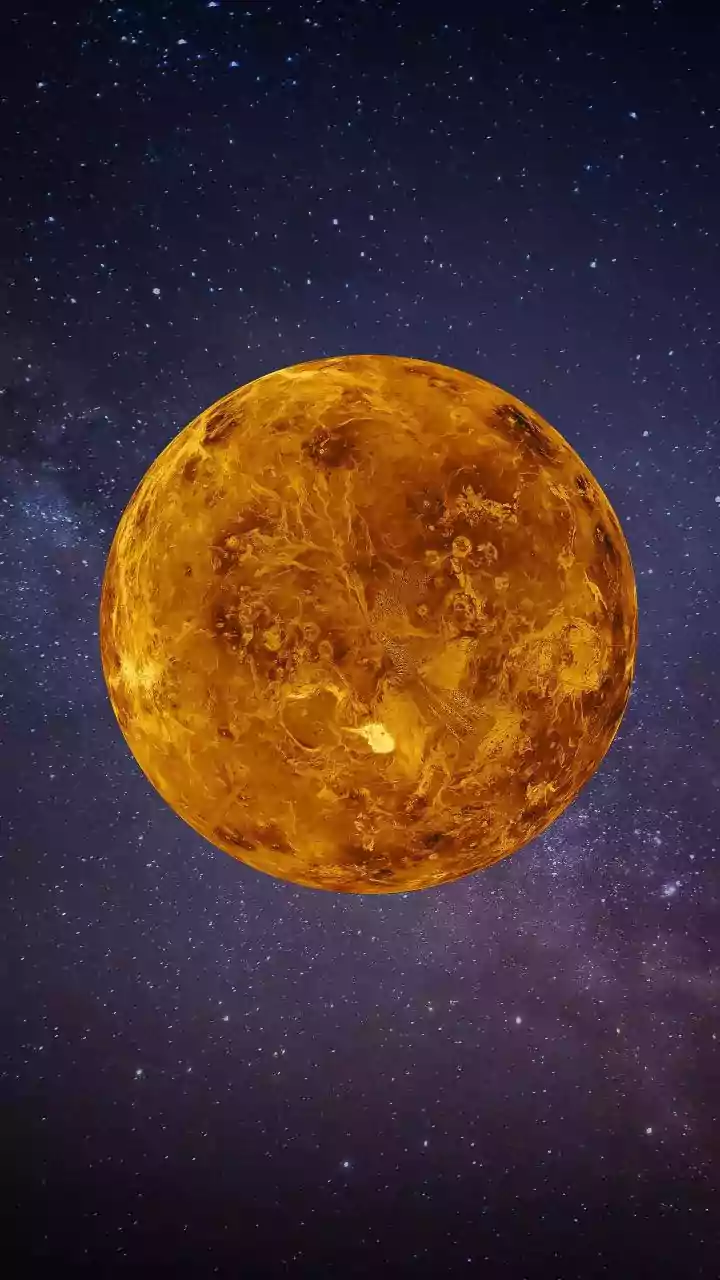
For centuries, Venus was a planet of mystery, its surface permanently shrouded by a thick layer of yellowish clouds. We couldn't visually track surface features to measure its rotation as we could with Mars. The breakthrough came with the advent of radar technology. In the 1960s, ground-based radar observations first hinted at the slow, retrograde spin. This was later confirmed in stunning detail by NASA's Magellan mission in the 1990s, which used powerful radar to map over 98% of the planet's surface, giving us our first clear look at the world beneath the clouds and confirming its bizarre rotational dynamics.