




An Icy Surprise in the Tropics
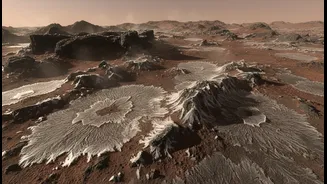
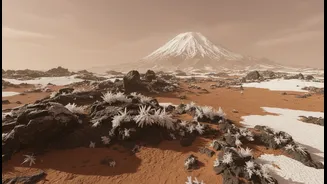
Scientists were taken by surprise when data from the European Space Agency’s Mars orbiters revealed something extraordinary: patches of water frost glistening on the peaks of the colossal Tharsis volcanoes. This region, home to Olympus Mons, the tallest
volcano in our solar system, is located near the Martian equator. For years, it was believed that the combination of intense sunlight and the planet's thin atmosphere made it impossible for frost to form in its tropical regions. The discovery, made by the ExoMars Trace Gas Orbiter and the veteran Mars Express spacecraft, challenges long-held assumptions about the Martian climate. Adomas Valantinas, the researcher who first spotted the frost, called its existence “exciting,” noting that it hints at “exceptional processes at play.”
A Unique Microclimate at Work
So, how can frost form in such an unlikely location? The answer lies in a unique microclimate created within the massive, bowl-shaped craters, known as calderas, at the summits of these volcanoes. Researchers propose that winds carry relatively moist air up the towering slopes of the mountains. As the air reaches higher altitudes within the calderas, it cools and condenses. This process allows a thin layer of water ice to settle on the surface, particularly in shadowed areas where temperatures are coldest. It’s an Earth-like phenomenon that scientists didn't expect to see on Mars, where mountaintops are not typically colder than the plains due to the low atmospheric pressure. This newly identified mechanism paints a picture of a far more dynamic Martian atmosphere than previously understood.
A Thin Layer with Huge Implications
The layer of frost is incredibly thin—about the width of a human hair. It appears for just a few hours around sunrise before the morning sunlight causes it to evaporate back into the atmosphere. While the deposit is fleeting, its scale is immense. Scientists calculate that during the colder seasons, about 150,000 tonnes of water—equivalent to the volume of 60 Olympic-sized swimming pools—are exchanged between the surface and the atmosphere each day. This represents a significant and previously unknown component of the Martian water cycle. Understanding where water exists on Mars and how it moves is not just a scientific curiosity; it’s crucial for future robotic and human exploration, as water is a vital resource.
Rewriting Our View of the Red Planet
This discovery does more than just add a new detail to our map of Mars; it helps transform our fundamental perception of the planet. Mars is not a static, geologically dead world. Instead, it is a place with active and complex systems, from its atmosphere to its surface. The presence of these daily frost cycles suggests an active exchange of water is happening right now, reshaping the landscape on a microscopic level. Some scientists suggest what we are seeing today may even be a remnant of an ancient climate cycle on Mars, one where precipitation and perhaps even snowfall occurred on these very volcanoes. Each new observation adds another brushstroke to a portrait of a planet that continues to hold many of its secrets close.