






An Enduring Cosmic Mystery
Black holes are regions of spacetime where gravity is so intense that nothing, not even light, can escape. This makes them impossible to see directly. For decades, astronomers have had to rely on indirect methods to study them, like observing the wobble
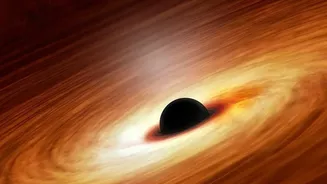
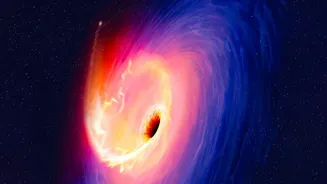
of nearby stars or detecting the intense X-rays blasted out by superheated gas spiraling into the abyss. These methods confirmed their existence but left many questions unanswered about the chaotic process of a black hole 'feeding'. We knew matter formed a glowing, swirling platter called an accretion disk before taking the final plunge, but seeing the full story unfold from start to finish remained a challenge.
Eyes on the Sky
The breakthrough came not from one instrument, but a host of them working in concert. In January 2005, the William Herschel Telescope in the Canary Islands spotted a bright flare of infrared light from a pair of colliding galaxies 150 million light-years away. This initial alert triggered a decade-long observation campaign. Scientists used an array of powerful tools, including NASA's Spitzer Space Telescope and the National Science Foundation's Very Long Baseline Array (VLBA), a network of ten radio telescopes. This multi-wavelength approach allowed them to see what was happening across different energy levels, from radio waves to infrared, painting a far more complete picture than a single satellite ever could. Other missions like ESA's XMM-Newton and Integral observatories are also crucial for studying the high-energy environments around black holes.
A Ten-Year Vigil
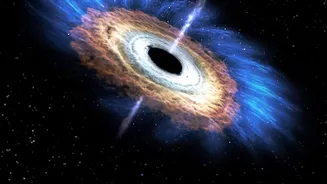
For the next ten years, astronomers kept their collective eyes on this distant galactic collision. What they were watching was a 'tidal disruption event' (TDE), a celestial catastrophe where a star wanders too close to a supermassive black hole and is torn apart by its immense gravity. The initial flare spotted in 2005 was the moment the star was shredded. As the star's matter was pulled into a swirling disk around the black hole, it heated up and radiated brightly, but this light was obscured by a thick shroud of dust surrounding the galactic core. This dust absorbed the visible light and re-radiated it as the infrared and radio signals that the telescopes on Earth could detect.
The Anatomy of a Feast
By patiently tracking the radio signals over a decade, scientists were able to witness something they had theorized but never seen so clearly: the formation and evolution of a jet of particles being ejected from the black hole. As the black hole devoured the stellar material, not all of it fell past the event horizon. A significant portion was funneled by intense magnetic fields and blasted back out into space in a narrow, super-fast jet. The team was able to track the motion of this jet as it moved outward. This was a monumental achievement, providing the first clear, resolved images of such a jet forming after a star's destruction. The observations showed that the initial flare was the star's demise, and the long, slow dimming over the years was the black hole consuming the stellar leftovers.
What This Discovery Means
This decade-long study has profound implications. It provides the strongest evidence yet linking a tidal disruption event to the launching of a relativistic jet, confirming a key piece of black hole theory. By observing this process, scientists can refine their models of how black holes grow and how they influence their host galaxies. These powerful jets can pump enormous amounts of energy into the surrounding space, affecting star formation and the galaxy's overall evolution. This event essentially provided a real-world laboratory to test theories about the most extreme environments in the universe. It also gives astronomers a new, distinct signature to look for when hunting for other previously hidden supermassive black holes.