



A New Chapter in Cosmic Exploration
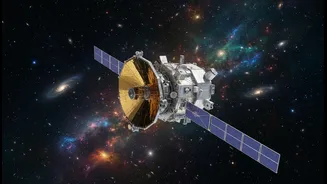
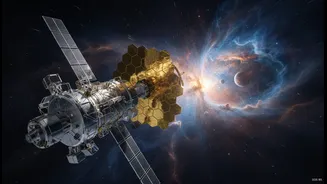
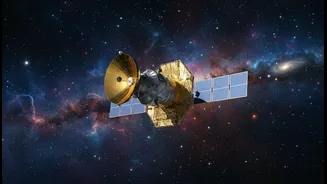
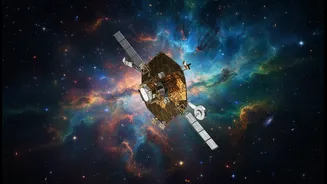
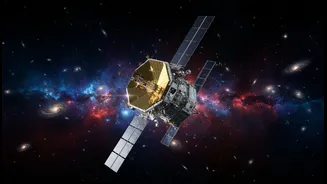
Set to launch aboard a Falcon Heavy rocket on August 30, 2026, the Nancy Grace Roman Space Telescope represents the next generation of space-based observatories. Named after NASA's first chief of astronomy, who was instrumental in the development of the Hubble
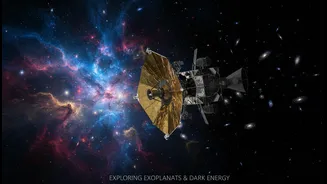
Space Telescope, Roman is designed not just to see farther, but to see wider. While its predecessors like Hubble and the James Webb Space Telescope (JWST) act like magnifying glasses, peering deep into small patches of the sky, Roman will be a panoramic camera, capturing vast cosmic landscapes in a single shot. With a primary mirror the same size as Hubble's at 2.4 meters, its mission is to tackle some of the biggest questions in astronomy today, including the nature of dark energy and the census of planets beyond our solar system.
The Power of a Panoramic View
Roman's primary advantage is its incredible field of view. Its Wide-Field Instrument (WFI) can capture an area of the sky at least 100 times larger than Hubble's or Webb's infrared cameras can in a single observation. To put that in perspective, while Hubble would need to take hundreds of pictures to create a mosaic of our neighboring Andromeda galaxy, Roman could cover it in just two. This ability to survey the sky at high resolution and incredible speed is what allows it to go beyond traditional limits. It’s not about replacing its predecessors; it's about complementing them. Roman will be the ultimate scout, identifying targets and mapping huge areas, while Webb and Hubble can zoom in for detailed follow-up studies on the most interesting discoveries.
Hunting for Dark Energy and Dark Matter
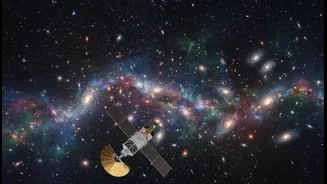
One of Roman’s primary science objectives is to solve the mystery of dark energy, the enigmatic force causing the universe's expansion to accelerate. No one knows what it is, but it makes up an estimated 68% of the cosmos. Roman will tackle this by mapping the distribution of billions of galaxies and clusters through cosmic time. It will also hunt for thousands of Type Ia supernovae, a specific type of stellar explosion whose consistent brightness allows astronomers to measure cosmic distances with great accuracy. By creating these vast 3D maps and tracking the expansion history of the universe with unprecedented precision, scientists hope to understand how dark energy's influence has changed over billions of years.
A Galactic Planet Census
Beyond cosmology, Roman is set to revolutionize the search for exoplanets. While the transit method (watching for a star's light to dim) has been fruitful, it's best at finding large planets close to their stars. Roman will use this method to potentially find 100,000 new planets, but its real game-changer is a technique called gravitational microlensing. This method, predicted by Einstein, occurs when a star or planet passes in front of a more distant star, and its gravity acts like a lens, briefly magnifying the background star's light. This technique is sensitive enough to find planets with masses as small as Mars and even free-floating 'rogue' planets not bound to any star. This will provide a more complete statistical census of planets in our galaxy.
Demonstrating Future Technology
In addition to its wide-field surveys, Roman will carry a technology demonstrator called the Coronagraph Instrument. A coronagraph is designed to block the overwhelming glare of a star, making it possible to directly image the much fainter planets orbiting it. This is like blocking the sun with your hand to see something next to it. While Roman's coronagraph is primarily a testbed for future missions like the Habitable Worlds Observatory, it will provide the first direct images and spectra of planets similar to our own gas giants around nearby stars. It’s a critical step toward the ultimate goal of taking a direct picture of a rocky, Earth-like planet and analyzing its atmosphere for signs of life.