
The Cosmic Fingerprint in Light
To understand how the JWST finds water, we first need to appreciate that light carries hidden information. When light from a star passes through a substance, like the atmosphere of a planet, certain elements and molecules in that atmosphere will absorb
very specific colours, or wavelengths, of that light. Every molecule has a unique absorption pattern, like a barcode or a fingerprint. Water (H2O), methane (CH4), and carbon dioxide (CO2) all block different, predictable parts of the light spectrum. By capturing the light that has traveled through an atmosphere, scientists can see which colours are missing and work backward to identify the molecules responsible. This powerful technique is known as spectroscopy.
The Transit Method: An Atmospheric Filter
The primary method JWST uses for this analysis is called transit spectroscopy. Scientists wait for a distant planet, or exoplanet, to pass in front of its host star from our point of view. This event is called a 'transit'. As the exoplanet crosses its star, a tiny fraction of the starlight shines directly through the upper layers of the planet's atmosphere. For a brief period, that atmosphere acts like a massive filter. The telescope’s incredibly sensitive instruments measure the starlight before, during, and after the transit. The difference between these measurements reveals exactly which wavelengths of light were filtered out by the planet’s atmosphere as it passed by.
Decoding the Water Signature
This is where it all comes together. The light collected during a transit is spread out into a spectrum, which is essentially a rainbow of infrared light that is invisible to the human eye. Scientists then look for specific 'dips' in this spectrum—dark lines where light has been absorbed. If they see a significant dip at the precise wavelength known to be absorbed by water vapor, they can confidently conclude that water is present in that distant atmosphere. The size of the dip can even give clues about the amount of water present. JWST's high precision allows it to detect these incredibly subtle changes, even for planets hundreds of light-years away.
JWST’s Specialist Toolkit
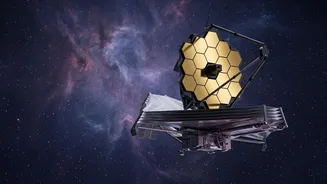
This remarkable feat is accomplished by a suite of advanced instruments aboard the telescope. Two of the key players are the Near-Infrared Spectrograph (NIRSpec) and the Near-Infrared Imager and Slitless Spectrograph (NIRISS). NIRSpec is designed to capture high-resolution spectra from 0.6 to 5.3 microns, a range that covers the tell-tale signatures of many important molecules, including water. NIRISS is also crucial, specializing in high-precision spectroscopy ideal for observing transiting exoplanets. By using these instruments, sometimes in combination, astronomers can obtain a comprehensive view of an exoplanet’s atmospheric chemistry and cross-check their findings to ensure accuracy.
Why Finding Water Is a Game-Changer
The detection of water vapor is a monumental step in the search for life beyond Earth. While finding water on a scorching hot gas giant doesn't mean we've found aliens, it demonstrates that a key ingredient for life as we know it can exist in diverse planetary systems. It helps scientists understand how planets form and whether the building blocks of life are common or rare throughout the galaxy. Each detection of water, whether on a rocky super-Earth or a gassy Neptune-like world, provides another crucial data point. It refines our models of planetary formation and brings us one step closer to answering the ultimate question: are we alone?