







The Tyranny of Single-Use Rockets
Historically, the economics of space travel have been brutal. Imagine flying a commercial airliner from Mumbai to New York, and then scrapping the entire aircraft upon arrival. This has been the standard model for rocketry. The vast majority of a launch's
cost is in building the rocket itself, which is then destroyed during its mission. Even partially reusable systems like SpaceX's own Falcon 9, while revolutionary, still discard their upper stages. This fundamental inefficiency has kept the cost per kilogram to orbit astronomically high, limiting deep space missions to bespoke, incredibly expensive projects sponsored only by the largest government agencies. This model makes ambitious goals like establishing bases on the Moon or Mars a financial fantasy.
Engineering for an Encore Performance
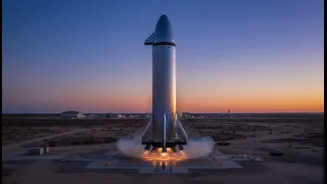
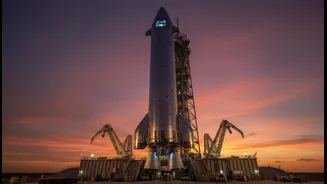
Starship was designed from the ground up to shatter this paradigm by making the entire launch vehicle—both the Super Heavy booster and the Starship upper stage—fully and rapidly reusable. This required solving immense engineering challenges. The vehicle is constructed from stainless steel to withstand the intense heat of atmospheric reentry, protected by thousands of thermal tiles. Its Raptor engines are designed for repeated use, burning methane and liquid oxygen, which is not only efficient but also makes future refueling on Mars theoretically possible using local resources. Perhaps the most audacious element is the plan to catch both the booster and the ship with the launch tower's mechanical arms, allowing for rapid turnaround and relaunch, much like an aircraft at an airport gate.
Milestones From Theory to Reality
The journey from blueprint to a working reusable system has been a step-by-step process of testing, failing, and iterating. Recent flight tests have demonstrated critical capabilities that were once purely theoretical. The program has successfully launched the massive two-stage vehicle, performed the 'hot-staging' maneuver where the upper stage engines ignite before separation, and achieved controlled landings for both the Super Heavy booster and the Starship spacecraft. A major validation came with the successful return of a booster to the launch site, where it was caught by the launch tower's arms—a world-first maneuver essential for rapid reuse. Each successful flight proves the viability of the design, from the performance of the heat shield to the precise control needed for vertical landings.
The Power of Lowering Costs
Every reusability milestone directly validates the business case for deep space exploration. The goal is to slash the cost of launching a kilogram to orbit by a factor of 100 or more. By reusing the entire system, the primary cost of a launch shifts from manufacturing to propellant and operations, which are a tiny fraction of the total. SpaceX's stated goal is to lower the cost per launch to as little as $10 million, capable of delivering over 100 metric tons to orbit. This dramatic cost reduction fundamentally changes the equation for what is possible. It makes projects that would have been budget-breakingly expensive, like delivering the infrastructure for a lunar base or sending fleets of cargo ships to Mars, financially plausible.
Unlocking the Moon, Mars, and Beyond
Starship's demonstrated progress is why it's at the heart of NASA's Artemis program, selected as the Human Landing System to return astronauts to the Moon. Its massive payload capacity and reusability will enable the delivery of habitats, rovers, and scientific equipment needed for a sustainable lunar presence. Beyond the Moon, these same capabilities make a city on Mars a tangible long-term objective. The ability to launch frequently and affordably means humanity can build infrastructure in space, from large telescopes to in-orbit refueling depots that would allow Starship to venture even deeper into the solar system. The engineering milestones are not just about perfecting a rocket; they are about proving the economic foundation upon which the future of human space exploration will be built.