


An Ocean World Hiding in Plain Sight
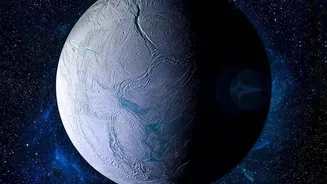
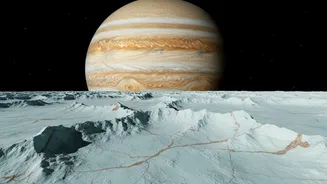
Europa is slightly smaller than Earth’s moon, but it’s one of the most compelling places to search for life beyond our planet. Its surface is the smoothest of any solid body in the solar system, a vast, frozen expanse crisscrossed with cracks and reddish-brown
streaks. But the real excitement lies beneath. Scientists have multiple lines of strong evidence suggesting that under this icy crust, which could be several kilometres thick, there is a global ocean of liquid saltwater. In fact, this ocean is estimated to contain more than twice as much water as all of Earth's oceans combined. The main clue came from NASA’s Galileo mission in the 1990s, which detected an induced magnetic field within Europa. This signature strongly implies the presence of a global conductor, like a salty ocean. This hidden ocean makes Europa a primary target in the search for habitable environments.
The Ingredients for Life
Life as we know it requires three key ingredients: liquid water, essential chemical elements, and an energy source. Europa appears to have all three. The massive subsurface ocean provides the water. The necessary chemical building blocks for life—like carbon, hydrogen, nitrogen, and oxygen—are believed to be present, potentially delivered by comets or arising from the moon's rocky seafloor. The energy component is perhaps the most intriguing. Being so far from the Sun, Europa can't rely on sunlight to power an ecosystem. Instead, energy may come from tidal flexing. As Europa orbits the immense gravitational pull of Jupiter, it is constantly squeezed and stretched, which generates heat in its interior. This process could keep the ocean liquid and may power hydrothermal vents on the seafloor, similar to those on Earth that support rich ecosystems teeming with life, completely independent of the Sun.
Meet the Europa Clipper
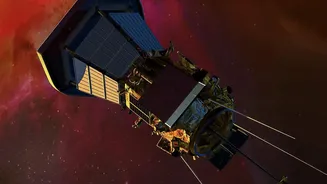
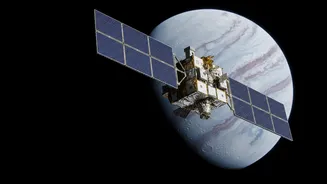
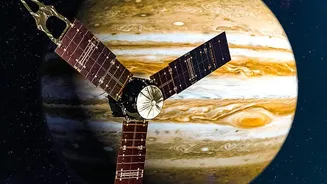
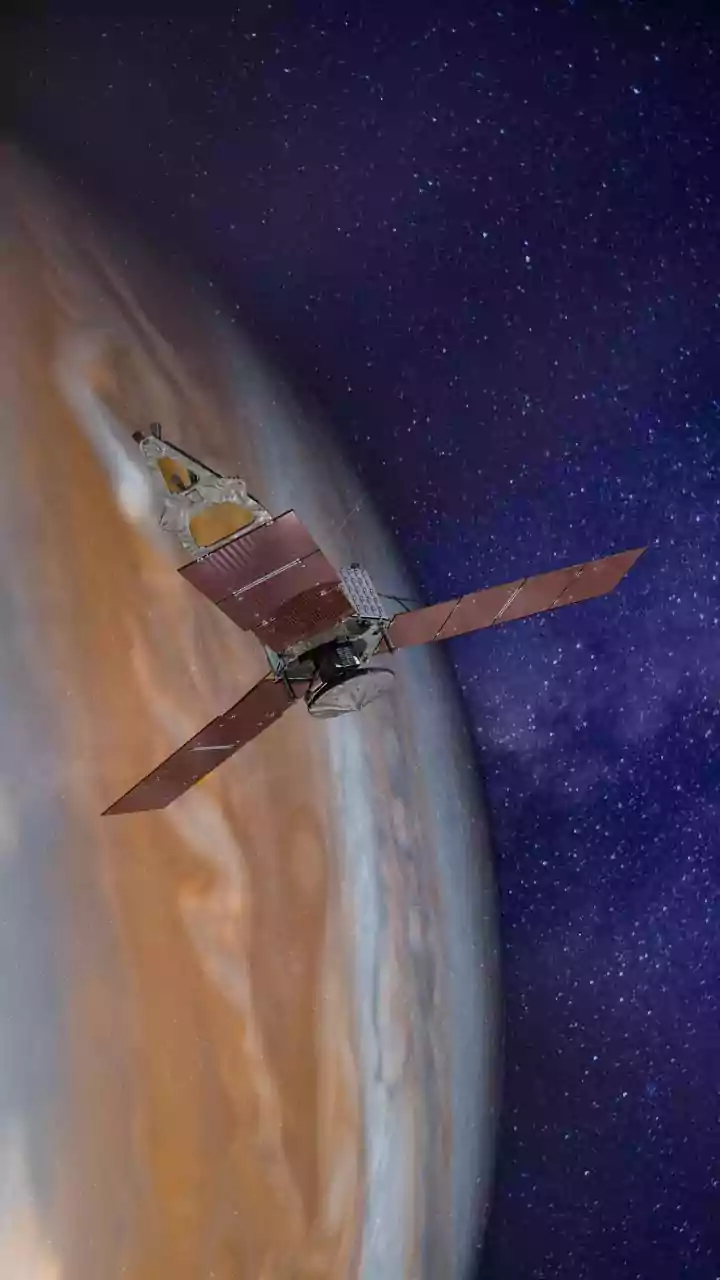
To investigate Europa’s potential for life, NASA launched the Europa Clipper spacecraft in October 2024. It’s the largest interplanetary spacecraft NASA has ever built, with solar arrays spanning the length of a basketball court. After a long journey that includes gravity assists from Mars in 2025 and Earth in December 2026, Clipper is scheduled to arrive in orbit around Jupiter in April 2030. Instead of orbiting Europa directly, which would expose it to Jupiter’s intense and damaging radiation, the spacecraft will orbit Jupiter and perform dozens of close flybys of the moon. During these encounters, it will dip as low as 25 kilometres above the surface, gathering detailed measurements before retreating to a safer distance. This strategy allows for a thorough investigation of the moon while protecting the sensitive scientific instruments.
Searching for Signs of Habitability
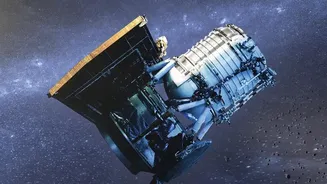
It's important to understand that Europa Clipper is not a life-detection mission; its goal is to determine if Europa is habitable. To do this, it carries a sophisticated suite of nine science instruments. Cameras will map the surface in high resolution, while an ice-penetrating radar will measure the thickness of the ice shell and search for pockets of liquid water within or beneath it. Spectrometers will analyse the chemical composition of the surface, looking for salts and organic molecules that might hint at the chemistry of the ocean below. Scientists are particularly hopeful that Clipper might be able to fly through and sample plumes of water vapour that are believed to occasionally erupt from Europa’s surface. If these plumes originate from the ocean, they could provide a direct sample of its contents, offering a glimpse into that hidden world without having to drill through the ice.
What Would Finding Microbes Mean?
While Clipper won't be looking for microbes directly, it is searching for 'biosignatures'—chemical traces that are strongly suggestive of biological processes. These could include specific ratios of organic molecules or certain isotopes that, on Earth, are associated with life. Discovering such signs would be a monumental moment in human history. It would suggest that life is not a unique fluke of Earth but can arise independently in other environments. Finding life, even simple microbial life, in our own solar system would dramatically increase the odds that life is common throughout the universe. It would confirm that the 'habitable zone' isn't just about distance from a star, but that internal heating can create liquid water oceans on icy moons far from the Sun. A positive finding would reshape our understanding of our place in the cosmos and undoubtedly trigger a new era of exploration, likely accelerating plans for a future lander mission to Europa.