


An Invisible High-Speed Threat
Imagine a highway where every abandoned car continues to travel at over 28,000 kilometres per hour. That’s the reality in Low Earth Orbit (LEO), the vital orbital band that hosts thousands of satellites for communication, navigation, and science. Decades
of space activity have left behind a cloud of defunct objects. NASA and other agencies track over 30,000 items larger than a softball, but there are an estimated 100 million pieces of debris larger than a millimetre. At orbital velocities, a collision with an object as small as a marble can be catastrophic, destroying a multi-million-dollar satellite and creating thousands of new fragments. Experts fear a tipping point known as the “Kessler Syndrome,” a chain reaction where collisions generate more debris, leading to more collisions, potentially rendering entire orbits unusable for generations.
The Magnetic Grab
The term “magnetic net” evokes an image of sweeping up junk, but the real-world application is more of a precise, magnetic handshake. The leading example comes from the Japanese company Astroscale. Its ELSA-d mission successfully demonstrated a system where a “servicer” spacecraft repeatedly docked with and released a “client” satellite using a magnetic plate. The idea is for future satellites to be launched with this ferromagnetic plate already installed. When the satellite reaches the end of its life, a servicer can easily locate it, latch on magnetically, and guide it into the atmosphere to burn up. This method is ideal for “cooperative” targets that were designed for removal. Other concepts involve using powerful electromagnets to create a magnetic field that can slow down and manipulate even non-magnetic but conductive debris, like objects made of aluminum, without ever touching them.
The Brute-Force Capture
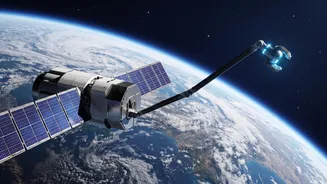
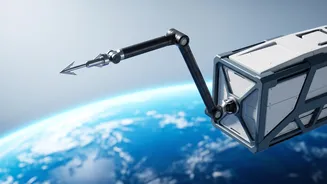
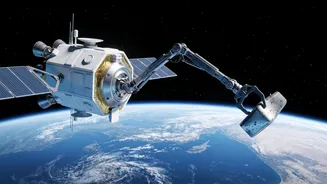
Not all space junk was designed to be caught. For older, unresponsive targets, a more forceful approach is needed. The European Space Agency (ESA) is pioneering this with its ClearSpace-1 mission, slated for launch in 2028. Led by Swiss startup ClearSpace, the mission will send a chaser spacecraft to hunt down a piece of a Vega rocket adapter that has been in orbit since 2013. Instead of a magnet, ClearSpace-1 will use a set of four robotic arms to form a “claw,” grabbing the tumbling object and holding it tight. Once secured, the chaser will act like a tow truck, dragging the debris down to a lower altitude where both will be incinerated upon re-entry. In a similar vein, Airbus and ESA have also tested a more literal harpoon—a projectile fired from a chaser to pierce the hull of a derelict satellite or rocket stage, allowing it to be reeled in on a tether.
The Laser Nudge
Perhaps the most futuristic concept is the “laser harpoon,” though in reality it functions more like a gentle push than a spear. Often called a “laser broom,” this method involves targeting debris with a high-powered laser from the ground or from another satellite. The beam doesn’t vaporize the object. Instead, it heats a tiny spot on its surface, causing a small amount of material to ablate, or turn into a puff of plasma. This plasma plume acts like a tiny rocket thruster, giving the piece of debris a nudge. By carefully timing these pulses, scientists can alter the object's trajectory, pushing it into a lower orbit where atmospheric drag will take over and cause it to burn up much sooner. This technique is seen as a promising way to deal with the vast population of smaller debris, between one and ten centimetres in size, that is too small to capture with a net or claw but still large enough to cause immense damage.