





1. Peer Through the Dust
The most striking feature of Centaurus A in older images is the dark, broad lane of dust that slashes across its middle, hiding the galactic center from view. But Webb is an infrared telescope, meaning it sees light wavelengths that can pass straight
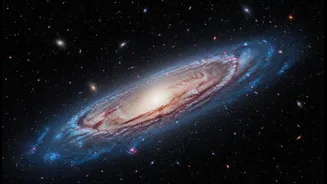
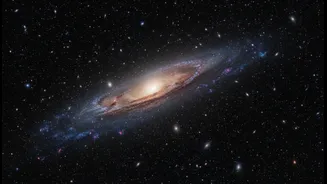
through this dust. In this new image, that dark lane is no longer a void but a glowing, intricate structure of golden-orange dust, shaped like a parallelogram. Webb's vision transforms this obscuring feature into a highlight, revealing the complex, warped disk of gas and dust left behind by a cosmic collision.
2. Find the Active Galactic Nucleus
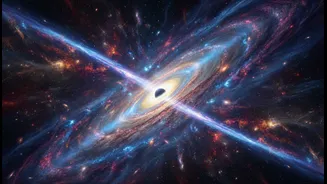
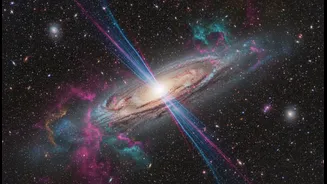
Now that you can see through the dust, look toward the very center of the galaxy. That brilliant white glow is the active galactic nucleus (AGN). This is where a supermassive black hole, with a mass of about 55 million times that of our Sun, is furiously consuming surrounding gas and dust. This 'feeding' process releases enormous amounts of energy, making Centaurus A's core shine brightly and launch powerful jets, making it the closest active galaxy to Earth.
3. Trace the Ghostly Jets
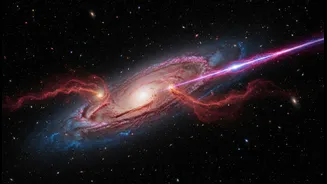
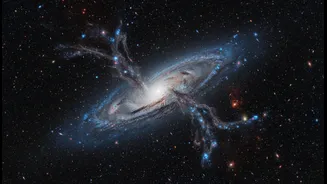
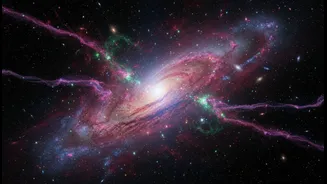
The supermassive black hole doesn't just pull things in; it also blasts material out. Look for faint, wispy structures extending from the core. These are relativistic jets—streams of high-energy particles moving at nearly half the speed of light. While radio telescopes are best at seeing the full extent of these jets, which stretch over a million light-years, Webb's instruments can see the glowing, ionized gas being pushed around by this activity near the galaxy's center. This helps astronomers study the complex relationship between a black hole and its host galaxy.
4. Count the Individual Stars
What might look like grainy texture or a hazy glow in the image is actually one of its most revolutionary features: countless individual stars. Previous telescopes, even powerful ones like Hubble and Spitzer, couldn't resolve the millions of stars packed into the galaxy's core because of the dust. Webb's clarity allows astronomers to see these stars one by one. This turns the image into a tool for 'galactic archaeology,' allowing scientists to study different generations of stars to reconstruct the galaxy's dramatic history.
5. Appreciate the Scars of a Collision
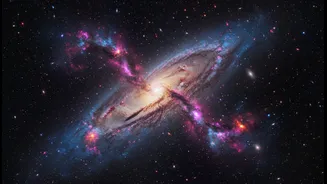
Centaurus A's peculiar shape is the result of a massive cosmic collision. About two billion years ago, a large elliptical galaxy merged with a smaller spiral galaxy. The entire image is a testament to this ancient crash. The warped dust lane, the flurry of new star formation, and the strange 'S' shaped feature near the core are all scars from this event. The collision provided a fresh supply of gas and dust, fueling both the birth of new stars and the activity of the central black hole.
6. Spot the Stellar Nurseries
Within the glowing dust lanes, look for bright red points of light, especially prominent in the mid-infrared (MIRI) view. Many of these are stellar nurseries—clouds of gas and dust that have been compressed and are now collapsing to form new stars. The merger that shaped Centaurus A triggered a firestorm of star birth that continues today. These glowing red patches show where future generations of stars and planets are being created from the raw materials shed by older stars and stirred up by the galactic collision.