







The Challenge of Predicting Plumes
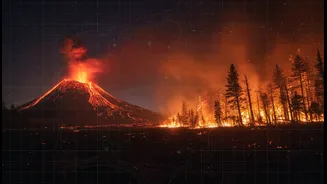
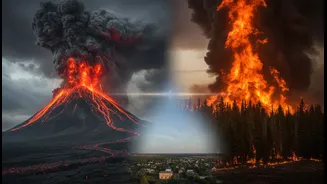
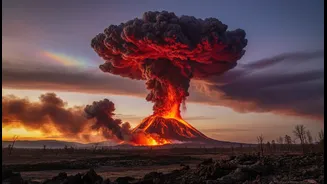
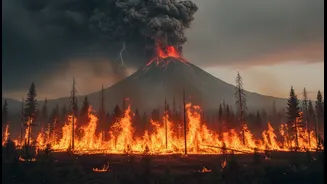
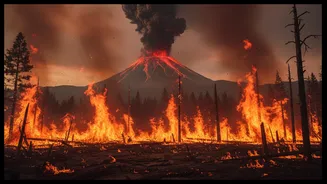
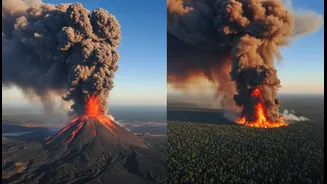
When a massive wildfire burns or a volcano erupts, one of the most immediate dangers beyond the fire or lava is the enormous plume of smoke, ash, and gas shot into the atmosphere. The direction and height of this plume determine air quality for millions,
ground aircraft, and can even alter local weather. For years, scientists have used complex computer models to forecast where these hazardous clouds will travel. These models act like sophisticated weather forecasts, but for smoke and ash, incorporating data on wind, temperature, and the fire or eruption itself. However, they have always faced a major source of uncertainty: accurately predicting the initial plume rise. How high the column of hot gas and particles initially rises is a critical starting point; getting it wrong can send the entire forecast in the wrong direction.
A Breakthrough in Plume Dynamics
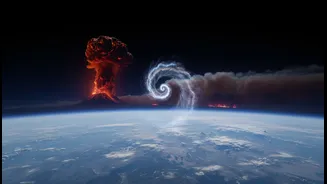
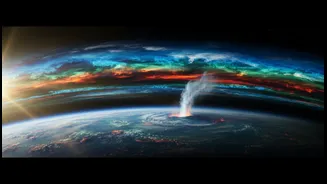
Recent research has delivered a significant refinement to these models. Scientists have developed new ways, often incorporating machine learning and artificial intelligence, to better simulate the complex physics inside a rising plume. One of the key processes is called 'entrainment,' which is how the turbulent, rising plume mixes with the clean air around it, causing it to widen and cool. Earlier models often struggled to capture this process perfectly. New approaches, trained on high-resolution simulations, can more accurately emulate these dynamics. This allows for a much better estimate of the plume's 'injection height'—the point at which it stops rising and begins to travel horizontally with the prevailing winds. This knowledge is being shared and transferred between the scientists who study wildfire smoke and those who study volcanic vog (volcanic smog), as the underlying physics are similar.
Refining Forecasts, Not Rewriting Them
This advance is a classic example of scientific progress: it's an important refinement, not a complete overhaul. The fundamental principles of atmospheric modeling remain the same. Forecasters are not throwing out their old playbooks but are instead getting a more precise tool for a crucial part of the equation. By combining high-resolution satellite data with AI-driven models, forecasters can now update their predictions more frequently and with greater detail. For instance, some newer models can update hourly, a significant improvement that captures sudden changes in fire behavior or weather. This is a move away from models that might only get new data when a satellite passes overhead twice a day, leaving long gaps where a fire's behavior could change dramatically. The result is a forecast that is more reliable in the critical first hours and days.
The Key Limitation: Data and Complexity
Despite these improvements, a key limit remains. The models are only as good as the data they are fed, and the real world is infinitely complex. For example, accurately modeling the initial fire requires detailed, real-time data on vegetation, terrain, and weather, which can be difficult to obtain, especially in remote areas. Furthermore, some of the newest machine learning models have their own limitations; they may not fully account for the effects of complex terrain or the immense amount of water vapor released by a fire, which can create its own weather systems. While AI can help speed up calculations and integrate more data, it also requires vast amounts of high-quality historical data to be trained effectively, which can be a challenge for rare, extreme events. Human interpretation of model outputs remains a critical step.
What This Means for Public Safety
For the public and for emergency responders, this refinement translates into more trustworthy warnings. A more accurate forecast for where a smoke plume will travel helps public health officials issue timely air quality alerts, especially for vulnerable populations. It allows aviation authorities to reroute flights with more confidence, avoiding both the danger of ash and the economic cost of overly broad no-fly zones. For firefighters, knowing how a fire's smoke will behave provides clues about the fire's potential growth and intensity, helping them make safer tactical decisions on the ground. While no forecast is perfect, each incremental improvement in accuracy provides a vital edge in mitigating the impacts of these increasingly common natural disasters.