



A Ghost in the Cosmic Machine
Imagine trying to spot a firefly in front of a searchlight thousands of kilometres away. That’s the challenge of finding distant planets. Most are discovered by detecting the faint dimming of a star as a planet passes in front of it. But this new giant,
a world several times more massive than our own Jupiter, was found using a method that is far more elegant and mind-bending. It was found hiding in a river of light from a much more distant star, its presence given away only by its immense gravity. This technique, called gravitational microlensing, allows astronomers to find worlds that are too far, too dim, or in orbits too wide to be detected by other means. These are the ghosts in the cosmic machine, and we are just now learning how to see them.
Einstein's Cosmic Magnifying Glass
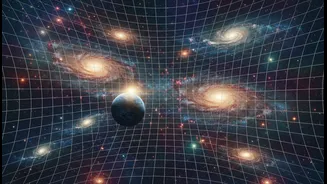
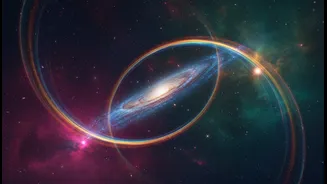
Over a century ago, Albert Einstein's theory of general relativity turned our understanding of gravity upside down. He proposed that massive objects don't just pull things toward them; they literally warp the fabric of space-time. A good analogy is placing a bowling ball on a trampoline—the heavy ball creates a dip in the fabric. Now, imagine rolling a marble nearby; it follows the curve created by the bowling ball. Light does the same thing. When a star passes directly in front of a more distant star from our point of view, its gravity can bend and magnify the background starlight like a lens. This creates a temporary, predictable brightening. But if that foreground star also has a planet, the planet's own, smaller gravity adds a brief, extra flicker to the light—a tiny anomaly that signals its existence.
Meet the New Super-Jupiter
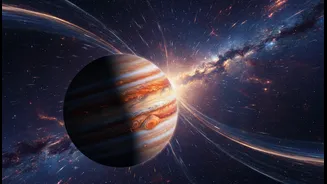
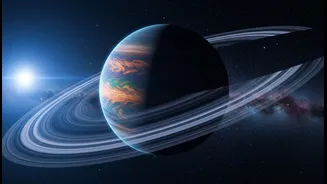
The newly detected world is a 'Super-Jupiter', a gas giant significantly more massive than the largest planet in our own solar system. These planets are true behemoths, but this one was found orbiting a star far less massive than our sun, thousands of light-years away toward the dense star-field of our galaxy's centre. The data revealed a planet with a mass several times that of Jupiter, orbiting its parent star at a distance comparable to the asteroid belt in our own solar system. Details are still emerging, but what is clear is that this is not a world that could have been easily found otherwise. The microlensing event was a one-time-only opportunity. If astronomers had missed that fleeting alignment, the planet would have remained completely invisible to us.
A Game of Perfect Alignment
Discoveries like this are exceptionally rare because they require a perfect, chance alignment between the distant source star, the closer 'lens' star with its planet, and us, the observers on Earth. Teams of astronomers monitor millions of stars every single night, waiting for one of them to begin brightening in the signature way that indicates a microlensing event is starting. When an event is flagged, telescopes around the world coordinate to watch it unfold, hoping to catch the tell-tale planetary 'blip' which might only last for a few hours. It's a cosmic needle in a haystack, requiring patience, precision, and a bit of luck. The fact that we are now finding these planets suggests that worlds like this—large, cold planets in wide orbits—might be quite common throughout the galaxy.
A New Window on the Universe
Each new exoplanet adds a piece to the puzzle of how solar systems form and evolve. But microlensing provides a unique perspective. Most other methods are biased toward finding planets that are either very large or very close to their stars. Microlensing is different; it is most sensitive to planets with masses similar to Jupiter or Neptune, orbiting at distances similar to those in our own solar system. It's also the only current method capable of finding planets at truly immense distances. Each microlensing discovery, therefore, doesn't just add another planet to the catalogue; it fills in a crucial gap in our knowledge, telling us about the kinds of planets that exist far from their stellar heat, in the cold, outer reaches of alien solar systems.