



A New Window on the Cosmos
For centuries, our view of star formation was partially blocked. Stellar nurseries, the vast clouds of gas and dust where stars are born, are notoriously opaque. Visible light telescopes, like the Hubble, could only see the surfaces of these dense clouds.
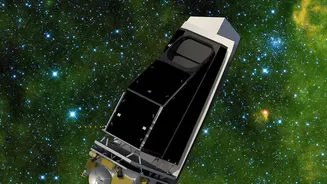
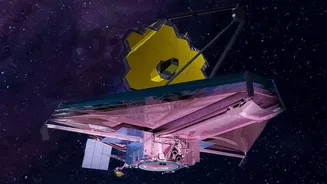
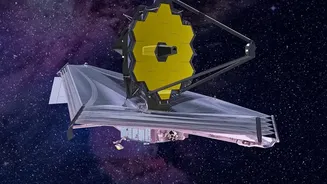
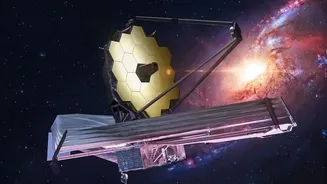
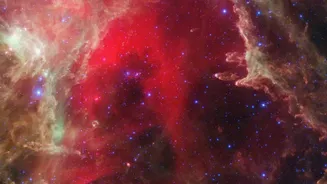
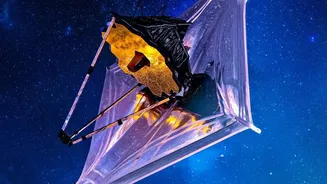
The James Webb Space Telescope (JWST) is a game-changer because it sees the universe in infrared light. This allows it to peer through the thick curtains of cosmic dust and gas, revealing the chaotic and beautiful processes happening deep inside. This technological leap is like trading an X-ray for a detailed MRI, giving scientists an unprecedented look at the earliest, most hidden phases of a star's life. The result is a stream of data that is reshaping theories about how planetary systems form.
Inside the 'Cosmic Cliffs'
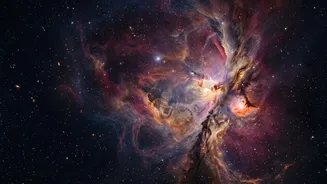
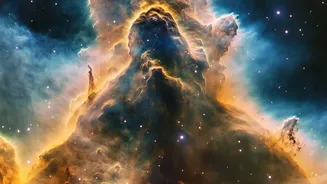
One of the most iconic early images from the JWST is of the 'Cosmic Cliffs' in the Carina Nebula, a star-forming region about 7,600 light-years away. What looks like a craggy mountain range is actually the edge of a giant, gaseous cavity. This cavern has been carved out by intense ultraviolet radiation and powerful stellar winds from massive, hot young stars located just out of frame. The 'steam' rising from the cliffs is hot gas and dust being blasted away by this energy. For the first time, Webb's unparalleled sensitivity has unveiled hundreds of previously hidden stars within these dusty pillars, along with protostellar jets shooting out from these nascent stars. Capturing this stage is incredibly valuable, as this very early period of star formation only lasts for about 50,000 to 100,000 years for an individual star.
Catching Protostars in the Act
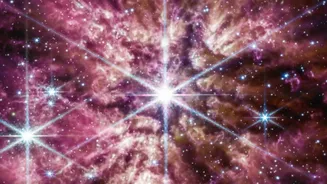
The most significant revelations from Webb concern protostars — the baby stage of a star's life. These are incredibly difficult to observe, but Webb can now see them clearly. The images reveal these infant stars still wrapped in the dense clouds they are forming from. Crucially, Webb has captured stunningly detailed images of bipolar jets, which are massive outflows of gas and material being ejected from the poles of these young stars. These jets, which can stretch for light-years, are a historical record of how a star grows, showing that it gobbles up material from its surrounding disk and violently ejects some of it. Webb's observations have even shown that in some regions, these jets are all aligned, suggesting the stars were born from the same spinning cloud and inherited its rotation.
How Young Stars Shape Their Worlds
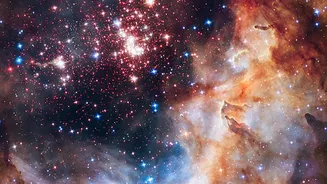
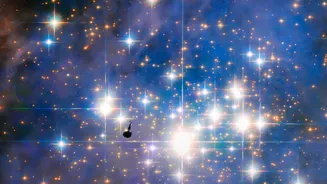
The JWST's images do more than just show how stars are born; they illustrate how stars interact with their environment. The powerful stellar winds and radiation from large, young stars have a dramatic effect on the surrounding nebula. They carve out huge bubbles and cavities in the gas and dust, as seen in the Carina and Triangulum galaxies. This process is a form of feedback. On one hand, the pressure from these winds can compress nearby gas, triggering a new wave of star formation. On the other hand, this same energy can also blow away the raw material, halting star birth in that region entirely. Understanding this delicate balance is key to figuring out why stars form in clusters and what determines the efficiency of star formation in a galaxy.
Rewriting the Cosmic History Books
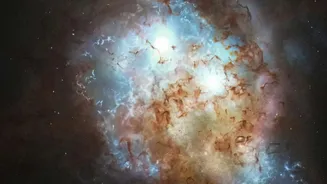
The clarity of Webb's vision is not just confirming old theories but also presenting new puzzles that challenge them. For instance, observations of some of the earliest galaxies are revealing they had a much higher proportion of small, faint stars than modern galaxies like our Milky Way. This implies that these ancient galaxies may have been up to four times more massive than previously estimated, deepening the mystery of how such huge structures could form so quickly after the Big Bang. Furthermore, Webb has detected unexpected high-energy radiation around some protostars, a phenomenon current models of star formation cannot fully explain. These findings show that the telescope isn't just a passive observer but an active tool forcing scientists to rethink fundamental assumptions about cosmic evolution.