





An Aviator's Paradise in the Outer Solar System
Imagine a world where the air is so thick and gravity so light that you could strap on a pair of wings and fly by simply flapping your arms. That world is Titan, Saturn's largest moon, and it's the destination for one of NASA's most ambitious missions
yet. While the Ingenuity helicopter captured the world's imagination by performing powered flight in the tissue-thin atmosphere of Mars, Titan presents a completely different and, in many ways, more favorable environment for aerial exploration. Its atmosphere is about four times denser than Earth's at the surface, with a pressure about 50% higher than what we experience. Combined with a surface gravity that is only about one-seventh of Earth's, the conditions on Titan make flight significantly easier to achieve and sustain.
More Science-Packed Drone Than Helicopter
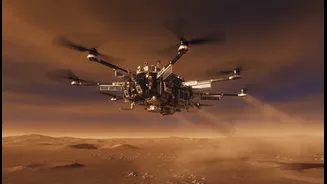
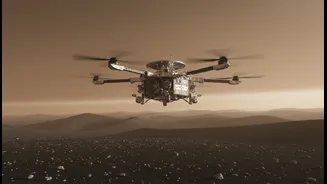
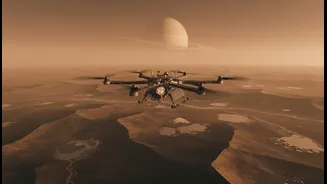
Dragonfly is not a delicate, lightweight helicopter like Ingenuity. It is a robust, car-sized rotorcraft lander, equipped with eight rotors in a dual-quadcopter configuration. This design allows it to carry a substantial suite of scientific instruments, something Ingenuity's featherweight frame could not manage. Instead of solar panels, which would be useless under Titan's thick, hazy sky and vast distance from the sun, Dragonfly will be powered by a Multi-Mission Radioisotope Thermoelectric Generator (MMRTG). This nuclear power source, similar to those used on the Curiosity and Perseverance Mars rovers, will provide consistent energy to fly, operate instruments, and stay warm in Titan's frigid -179°C temperatures.
A Mobile Lab in Search of Life's Ingredients
The primary goal of the Dragonfly mission is astrobiology. Titan is a fascinating target because it is rich in complex organic molecules, the carbon-based compounds that are the building blocks of life as we know it. This frigid moon has an Earth-like cycle of liquids, but with methane and ethane instead of water, complete with rivers, lakes, and rain. Dragonfly will act as a mobile geochemistry lab, flying from one location to another to sample and analyze the surface. Its instruments include a mass spectrometer to identify chemical compounds, a drill to collect samples from below the surface, and a suite of sensors to study the moon's weather and geology, including a seismometer to detect "Titanquakes". The mission will initially land in the Shangri-La dune fields and aims to later explore the Selk impact crater, where scientists believe liquid water may have mixed with organic materials in the past.
The Long Journey and Ambitious Itinerary
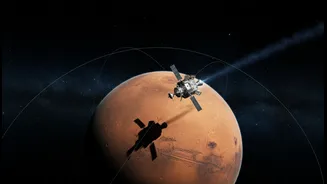
Getting this revolutionary explorer to the outer solar system is a marathon, not a sprint. Scheduled to launch aboard a SpaceX Falcon Heavy rocket in July 2028, Dragonfly will not arrive at Titan until 2034. Once there, it will embark on a mission lasting nearly three years, with the potential for much longer. During its time on Titan, Dragonfly is expected to fly to dozens of different locations, covering over 175 kilometers—farther than any wheeled rover has ever traveled on another world. The flights will be autonomous, as the one-way communication time from Earth to Titan is over an hour. The rotorcraft will take to the skies every 16 to 32 Earth days, exploring diverse environments and unlocking the secrets of a world that may hold clues to the origins of life itself.