




Seeing is Believing, and Also Time Traveling
Every time you look up at the night sky, you’re looking into the past. This isn't science fiction, but a fundamental fact of our universe. Light, as fast as it is, takes time to travel. The light from our own Moon is 1.3 seconds old by the time it reaches
us. For stars, it’s years. And for distant galaxies, it's billions of years. This means observing objects that are billions of light-years away is literally seeing them as they were billions of years ago. The James Webb Space Telescope (JWST) was specifically designed to capture this ancient light. Its powerful mirrors and extreme sensitivity to infrared light allow it to detect the faint glow from the universe’s infancy. As the universe has expanded over 13.8 billion years, the light from the first stars and galaxies has been stretched into longer, redder wavelengths—a phenomenon known as redshift. Webb is engineered to see this redshifted light, giving us a direct window into the cosmic dawn.
Nature's Own Magnifying Glass
As powerful as Webb is, it sometimes gets a cosmic boost from a phenomenon called gravitational lensing. Over a century ago, Albert Einstein’s theory of general relativity revealed that massive objects don’t just pull on other objects; they actually warp the fabric of spacetime itself. Imagine placing a bowling ball on a stretched-out sheet. It creates a dip, and any smaller marbles rolling nearby will have their paths curved by that indentation. Galaxy clusters—collections of hundreds or thousands of galaxies bound by gravity—are the bowling balls of the cosmos. Their immense mass creates such a significant warp in spacetime that they can bend and magnify the light from objects located directly behind them, from our point of view. This effect turns the galaxy cluster into a natural, albeit imperfect, telescope, creating distorted, stretched, and sometimes multiple images of the background galaxy. These warped shapes, often appearing as arcs or rings of light, are what astronomers call Einstein rings or arcs.
What Webb Sees Through the Lens
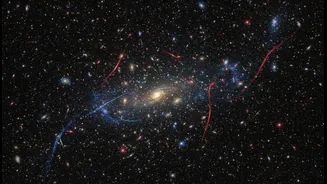
By aiming Webb at these massive galaxy clusters, astronomers are effectively using a two-stage telescope: one built by humans, and one built by nature. The lensing effect magnifies background galaxies that would otherwise be far too faint and distant to see. In recent observations, this technique has yielded incredible results. When Webb targeted the massive cluster known as 'El Gordo,' it revealed exquisitely detailed images of distant galaxies that were only faint smudges in previous views from the Hubble Space Telescope. One lensed galaxy, nicknamed 'The Fishhook' due to its curved shape, was seen as it existed when the universe was just a fraction of its current age. In another survey, called COSMOS-Web, researchers identified hundreds of new lensing candidates, providing a treasure trove of early-universe targets. Some of these discoveries allow scientists to study individual star clusters and even supernovae in the earliest galaxies, offering an unprecedented level of detail.
Unlocking the Secrets of the Cosmic Dawn
These lensed galaxies are more than just pretty pictures; they are crucial clues in the story of cosmic evolution. They provide a glimpse into the 'Epoch of Reionization,' a period from about 400 million to 1 billion years after the Big Bang, when the light from the first stars and galaxies burned through the neutral hydrogen fog that once filled the universe. By studying the chemical makeup and star formation rates in these ancient galaxies, scientists can piece together how the universe became the complex, structured cosmos we see today. For instance, recent Webb observations of a lensed galaxy cluster called XLSSC 122, seen as it was 10.4 billion years ago, are challenging existing models of how quickly such massive structures could form. The lensing effect also allows astronomers to map the distribution of dark matter, the invisible substance that makes up about 85% of the matter in the universe. Since dark matter's gravity contributes significantly to the lensing, the distortions in the background light can reveal where this mysterious substance is hiding.