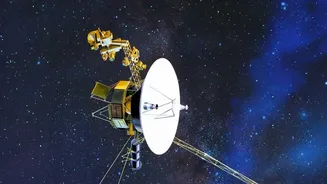


After a nail-biting 48-hour silence, NASA is back in contact with Voyager 1. The resilient 49-year-old probe fixed itself, continuing its lonely journey toward a milestone that will redefine what it means to be far from home.
A Signal from the Void
In mid-October 2026, humanity’s
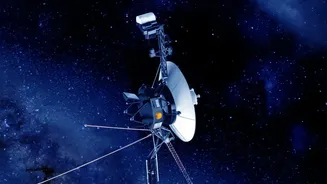
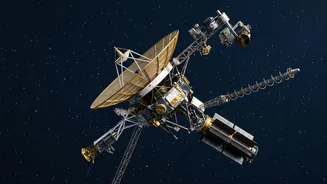
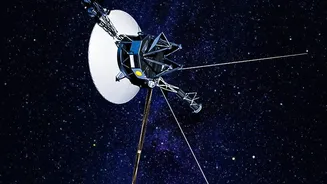
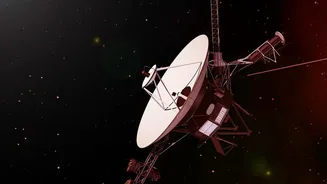
most distant emissary, the Voyager 1 spacecraft, suddenly went quiet. For two tense days, NASA's Deep Space Network, a global array of powerful antennas, strained to hear a signal and received only silence. The probe, travelling for nearly half a century, was more than 25 billion kilometres away in the vastness of interstellar space. Then, on October 20, as mysteriously as it vanished, the signal returned. Initial analysis from NASA's Jet Propulsion Laboratory (JPL) suggests the spacecraft's autonomous fault protection system kicked in, correctly identifying an issue with a group of thrusters and switching to a backup set. This self-rescue is a testament to the probe's robust 1970s engineering, allowing it to continue operating as it speeds towards its next great achievement.
The Challenge of Deep Space Communication
This recent scare is just the latest in a series of challenges for the aging explorer. In November 2023, the spacecraft began sending back a stream of gibberish, a problem that took engineers five months to solve. The issue was traced to a single faulty memory chip in the Flight Data Subsystem (FDS), the computer responsible for packaging science and engineering data for its long journey to Earth. Unable to repair the chip, the JPL team devised an ingenious workaround. They carefully divided the affected software code into smaller segments and stored them in different locations within the FDS memory. Sending these commands was an exercise in patience. With a one-way light-time of nearly 24 hours, it took two full days to send a command and receive a confirmation. The successful fix in the spring of 2024, which brought all four of its science instruments back online, was a masterclass in remote, interstellar repair.
The One-Light-Day Milestone
The successful recovery of communication comes just in time for a monumental event. On November 18, 2026, Voyager 1 will become the first human-made object to be one light-day away from Earth. A light-day is the distance light travels in 24 hours — approximately 25.9 billion kilometres. At that point, a radio message sent from NASA will take a full day to reach the spacecraft, and its reply will require another full day to travel back. This isn't a physical boundary, but a milestone of time and distance that highlights the sheer scale of Voyager's journey. It took the spacecraft 49 years to travel a distance that light crosses in a day. To celebrate, The Planetary Society is hosting a virtual event, and NASA is encouraging space enthusiasts to participate by shining flashlights skyward.
An Enduring Legacy of Exploration
Launched in 1977, Voyager 1’s original mission was to conduct a 'Grand Tour' of Jupiter and Saturn. It gave us our first detailed look at Jupiter’s turbulent atmosphere and the intricate workings of Saturn’s rings and moons. After its planetary encounters, its mission was extended. In 1990, it turned its camera back one last time to capture the iconic 'Pale Blue Dot' image of Earth. In August 2012, it officially entered interstellar space, crossing the heliopause where the Sun's influence gives way to the galactic medium. The data it continues to collect on plasma waves, magnetic fields, and cosmic rays provides invaluable information about the environment outside our solar bubble. However, the probe is running on borrowed time. Its plutonium power source loses about four watts of power each year, forcing engineers to make difficult decisions about which systems to shut down to conserve energy. A recent power-shuffling manoeuvre nicknamed the 'Big Bang' should help extend the life of its remaining science instruments, but the signal will inevitably grow too faint to detect, likely sometime in the next decade. Until then, Voyager 1 continues its silent, lonely trek, a testament to human ingenuity and our unyielding desire to explore the unknown.