







The Astronomical Dream
The fundamental mission of the Habitable Worlds Observatory is to do something humanity has only dreamed of: take a direct picture of a planet similar to our own orbiting a star like our sun and scan its atmosphere for signs of life. Recommended by the US
National Academies, this flagship mission is the spiritual successor to the Hubble and James Webb Space Telescopes (JWST) but is the first specifically designed to hunt for life. The goal is to identify at least 25 potentially habitable worlds and analyze their atmospheres for biosignatures—gases like oxygen, ozone, and methane that could point to biological processes. This would be a pivotal moment, potentially answering the age-old question, "Are we alone?". In addition to this primary goal, the HWO will be a powerful tool for general astrophysics, studying everything from the evolution of galaxies to the mysteries of our own solar system.
The Ten-Billion-to-One Problem
The dream of finding a pale blue dot in the cosmos runs into a staggering physical reality. An Earth-like planet is roughly 10 billion times fainter than its host star. Trying to see it is like trying to spot a firefly next to a searchlight from thousands of miles away. This is the central challenge for HWO's engineers. To succeed, the observatory needs to achieve a level of light suppression and stability that is orders of magnitude beyond any current technology. The James Webb telescope, for all its power, is not equipped for this specific task. The HWO represents what one official called "by far the most challenging observatory that we've ever built." This is not just about building a bigger telescope; it's about inventing entirely new ways to control light and maintain stability at a mind-boggling scale.
Mastering the Artificial Eclipse
At the heart of HWO's design is an instrument called a coronagraph. Its job is to create an artificial eclipse inside the telescope, blocking the blinding light of a distant star so the faint, reflected light from its planets can be seen. While the Nancy Grace Roman Space Telescope, set to launch in 2027, will feature a powerful coronagraph, the one required for HWO needs to be about 100 times more effective. This requires pushing the technology to its absolute limits. One concept involves using a deformable mirror with thousands of actuators that can adjust its shape with picometer precision—a fraction of the diameter of a single hydrogen atom. This 'active' mirror will constantly shift to cancel out stray starlight that leaks past the primary block, ensuring the planet's faint signal isn't lost in the noise.
An Unflinching, Ultra-Stable Eye
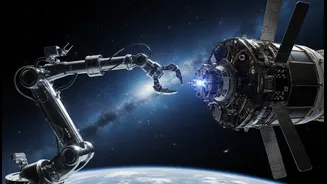
Even with the world's best coronagraph, the mission would fail if the telescope itself isn't phenomenally stable. The entire structure, from its large, segmented primary mirror—likely around 6 meters or more in diameter—to its instruments, cannot wobble or warp by more than a few picometers during long observations. Any tiny vibration or thermal expansion would allow starlight to leak around the coronagraph and ruin the image. Engineers are exploring advanced systems for thermal control and vibration dampening to achieve this unprecedented level of structural integrity. Furthermore, HWO will be designed for robotic servicing. Located a million miles from Earth, robotic missions could repair or upgrade the observatory, extending its life and allowing for future technologies to be installed decades from now. This mandate is a monumental engineering task in itself, requiring a modular design built for robotic hands.