






The Great Water Myth
Let’s clear this up straight away: a camel’s hump does not store water. It’s one of the most persistent myths in the animal kingdom, likely born from the camel’s incredible ability to survive for long periods without drinking. While these animals are
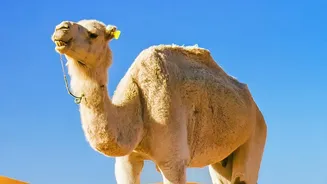
masters of hydration, their humps are not sloshing canteens. Cutting one open would reveal not a drop of water, but something far more crucial for desert survival. A well-fed camel's hump is firm and upright, while a camel that has gone a long time without food will have a hump that is limp and can even flop to one side, a clear visual indicator of its nutritional state.
A Hump Full of Fat
So, if not water, what is inside? The answer is fat. A camel's hump is a massive reservoir of fatty tissue. A single hump can store up to 36 kilograms of fat. This concentration of fat serves as a vital energy source. When food is scarce, which is common in a desert environment, the camel’s body metabolises this fat for nourishment, allowing it to go for weeks or even months without eating. This design is a brilliant evolutionary solution. By storing fat in one or two large humps on its back, the camel avoids having a layer of insulating fat all over its body, which would trap heat and make it difficult to stay cool in the scorching desert sun.
An Energy-Efficient Design
This localised fat storage is a genius thermoregulation strategy. By keeping the rest of its body lean, the camel can dissipate heat more efficiently during the hot days. At night, when desert temperatures can plummet, the body can better manage its temperature. While metabolising fat does produce a small amount of water as a byproduct, this 'metabolic water' is not nearly enough to sustain the animal. The main benefit of the fat is as a dense, long-lasting energy pack. This is why camel calves are not born with humps; they develop them as they wean and begin building their own fat reserves.
The Real Secrets to Staying Hydrated
The camel's true superpower for water conservation lies in a series of other remarkable adaptations, not its hump. Firstly, their red blood cells are oval-shaped, unlike the circular cells of most other mammals. This unique shape allows the cells to be more elastic, enabling them to handle large water intake without bursting and to continue flowing smoothly even when the camel is dehydrated. A thirsty camel can drink up to 115 litres in about 10 minutes. Furthermore, camels have highly efficient kidneys and intestines that extract nearly every last drop of moisture from their waste, producing thick urine and very dry dung. Their complex nasal passages even capture water vapour from their own breath, reabsorbing it back into the body.