

A Tale of Two Moons
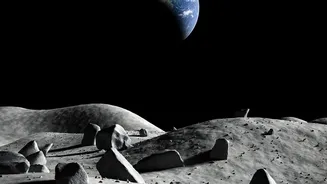
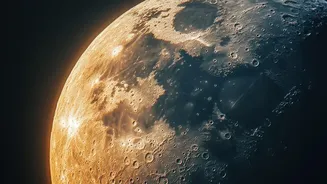
Ever since the Soviet Union's Luna 3 probe first photographed the Moon's farside in 1959, scientists have been stumped by a glaring difference: the two hemispheres are dramatically unalike. The nearside, which always faces Earth, is dominated by vast,
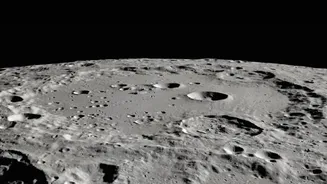
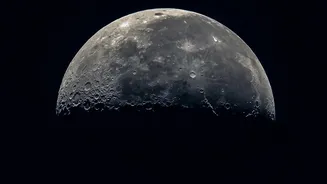
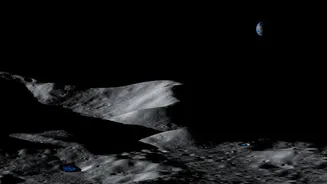
dark plains of ancient lava called 'maria'. In stark contrast, the farside is a rugged, heavily cratered landscape with a much thicker crust and very few maria. This stark contrast, known as the lunar dichotomy, has been one of the most persistent mysteries in planetary science. Scientists have long theorised about why this asymmetry exists, with ideas ranging from a giant ancient impact to uneven gravitational forces from Earth.
A Groundbreaking Mission
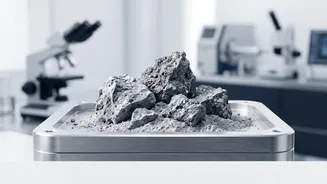
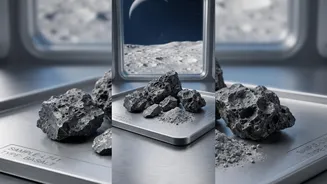
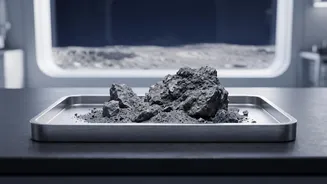
The key to solving the mystery lay hidden in the farside's soil, but getting there was a monumental challenge. In a historic achievement, China's Chang'e-6 mission successfully landed in the South Pole-Aitken (SPA) basin in June 2024 and returned the first-ever samples from this unexplored region. The SPA basin is the Moon's largest, oldest, and deepest impact crater, making it a prime location to study the Moon's early history. The 1,935 grams of rock and dust brought back to Earth have given scientists an unprecedented opportunity to directly compare material from both sides of the Moon for the first time.
Clues Written in the Rocks
Initial analysis of the Chang'e-6 samples has yielded fascinating results. Several studies published recently point to significant compositional differences between the farside and nearside. One study found that basalts from the farside formed from lava that was about 100°C cooler than the lava that formed the nearside plains. This suggests the interior of the Moon is not uniform and may be significantly cooler on the farside. Another study focused on isotopes of elements like potassium. They found that farside rocks have a higher proportion of heavier potassium isotopes. The researchers concluded this was likely caused by an extreme heating event, such as the massive impact that formed the SPA basin, which would have vaporised lighter isotopes.
Connecting Heat, Gravity, and Magma
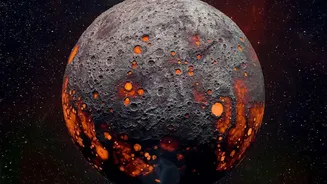
These findings are helping scientists assemble a more complete picture of the Moon's evolution. One leading theory, now bolstered by the sample data, suggests a combination of factors. Early in its history, when the Moon was still a molten ball of rock, it became tidally locked with Earth. The Earth's immense gravity may have caused uneven heating, warming the nearside more than the farside. This temperature difference could have triggered massive convection currents in the lunar magma ocean. Hotter, less dense material, including heat-producing elements like potassium and thorium, would have flowed toward the nearside. This concentration of radioactive elements kept the nearside warmer for longer, leading to a thinner crust and the extensive volcanic activity that formed the dark maria we see today. Meanwhile, the cooler farside developed a thicker, more stable crust.
Why the Moon's Past Matters
Solving the mystery of the Moon's two faces does more than satisfy scientific curiosity. Understanding the forces that shaped our celestial neighbour provides a crucial window into the formation and evolution of other rocky bodies in our solar system, including Earth itself. The processes of massive impacts, magma oceans, and crustal formation are fundamental to how planets develop. Furthermore, the practical knowledge gained from analysing the physical properties of the farside soil, which appears to be composed of sharper, more angular grains, is vital for future engineering projects, such as the planned construction of lunar research bases. These first samples are just the beginning, and further research will undoubtedly uncover more secrets hidden within the ancient rocks of the lunar farside.