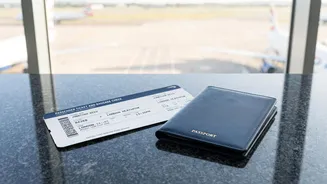







What is the Viral 'Hidden City' Hack?
The travel hack you’ve likely seen lighting up social media is a practice known as 'skiplagging' or 'hidden city ticketing'. The idea is simple: instead of booking a direct flight to your destination (City B), you book a cheaper flight that has a layover
in City B but is ultimately headed for City C. You then get off the plane at the layover airport—your actual destination—and simply don't board the connecting flight. The price difference can sometimes be significant because airline fares are based on market demand, not distance. A flight from Mumbai to Delhi, for example, might be more expensive than a less in-demand flight from Mumbai to Chandigarh that connects through Delhi. By booking the latter and walking out of the Delhi airport, travellers hope to save hundreds.
The All-Important Question: Does It Work?
In a purely transactional sense, yes, the savings can be real. Websites even exist specifically to find these hidden-city fares for you. The pricing anomaly is a genuine quirk of the airline industry's complex algorithms, where nonstop flights to major hubs are often priced at a premium compared to connecting flights that pass through them. So, if you find a flight from Bengaluru to Kolkata with a layover in Hyderabad that costs less than a direct flight to Hyderabad, you could theoretically save money by exiting at the layover. However, the potential savings come with a long list of serious risks and restrictions that most viral posts conveniently ignore.
The Major Risks You Can't Ignore
First and foremost, you cannot check any luggage. Your checked bags will always be sent to the final destination on your ticket (City C), not your layover city. This means you can only travel with a small carry-on that you are certain won't be gate-checked. Second, this only works for one-way tickets. If you skip a leg on a round-trip itinerary, airlines will automatically cancel all subsequent flights on your ticket, including your return journey. Finally, there's the risk of re-routing. If the airline experiences a delay or operational issue, they might reroute your flight to bypass your intended layover city altogether, leaving you stranded in a place you never intended to visit, with no recourse.
Is It Legal, and What Do Airlines Think?
While skiplagging is not technically illegal—you won't be arrested for it—it is a direct violation of the 'contract of carriage' you agree to when you purchase a ticket from nearly every major airline. Airlines explicitly forbid this practice and are actively cracking down on it. If you're caught, the consequences can be severe. An airline has the right to cancel your remaining itinerary, charge you the fare difference for the flight you actually took, revoke all your frequent flyer miles, and in some cases, ban you from flying with them in the future. For frequent travellers or those living in a city dominated by one carrier, getting banned can be a crippling penalty.
Safer, Smarter Ways to Find Cheap Flights
The risks associated with skiplagging often outweigh the rewards. Fortunately, there are many legitimate ways to find affordable airfare that don't violate airline policy. Flexibility is your biggest asset. Being open with your travel dates and even your destination can unlock huge savings. Using flight comparison tools like Google Flights or Skyscanner to set up fare alerts will notify you when prices drop for your desired route. Booking in the 'Goldilocks' window—typically 1-3 months for domestic flights and 2-8 for international—is another proven strategy, as last-minute flights are rarely cheaper. Finally, consider flying on Tuesdays, Wednesdays, or Saturdays, which are consistently less expensive than peak days like Friday and Sunday.