


A Cosmic Size Problem
For decades, the story of supermassive black holes seemed straightforward. A massive star collapses, creating a 'seed' black hole a few times the mass of our sun. Over billions of years, this seed gradually feeds on gas, dust, and other stars, and merges
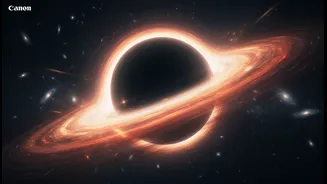
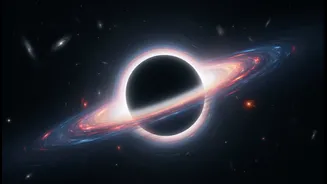
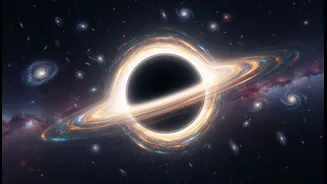
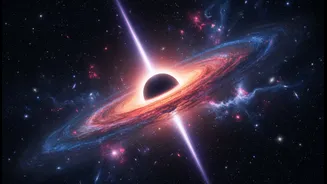
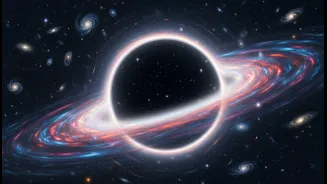
with other black holes, eventually growing into the giants we see at the center of most large galaxies today, including our own Milky Way. But new observations from the James Webb Space Telescope (JWST) are showing this story is, at best, incomplete. Astronomers are finding black holes that are millions or even billions of times the mass of the sun at a time when the universe was less than a billion years old. This is the cosmic equivalent of finding a fully grown adult in a nursery of newborns. There simply wasn't enough time for them to grow that large through conventional means.
Webb's Impossible Discoveries
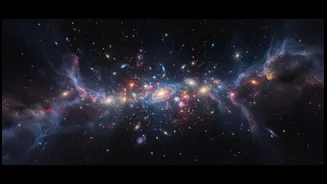
The JWST is a time machine, allowing scientists to see galaxies as they were shortly after the Big Bang. In this cosmic dawn, it has identified multiple 'overmassive' black holes. One prominent example is in a galaxy called GN-z11, seen as it was just 400 million years after the Big Bang. It hosts a black hole already around two million times the mass of our sun. Another, dubbed Abell2744-QSO1, existed just 700 million years post-Big Bang and contains a black hole weighing 50 million solar masses. In some of these early systems, the black hole's mass is a huge fraction of its host galaxy's mass—sometimes 100 times larger than the ratio seen in the modern universe, and in some cases, possibly even out-massing the galaxy's stars entirely. This upends the long-held idea that galaxies and their black holes grow in lockstep.
Rewriting the Rulebook
So, how did these giants get so big, so fast? Scientists are now racing to develop new theories. One leading idea is the 'direct collapse' model. Instead of starting from a single star, a colossal cloud of primordial gas in the early universe could have collapsed directly into a massive black hole 'seed' of 10,000 to 100,000 solar masses, giving it a significant head start. Another possibility involves periods of extreme, rapid growth known as 'super-Eddington accretion'. This is where a black hole pulls in matter much faster than the rate once thought to be the physical limit, essentially force-feeding itself in the gas-rich environment of the young cosmos. Some research even suggests that decaying dark matter could have given these primordial gas clouds the push they needed to collapse into black holes instead of forming stars.
A New View of the Dawn
This isn't just a black hole problem; it's a galaxy formation problem. The discovery that some black holes might have formed before the bulk of their host galaxies' stars is revolutionary. It suggests that, rather than being a consequence of galaxy formation, these massive black holes might be a cause, acting as gravitational anchors around which the first galaxies coalesced. The presence of these giants so early on impacts our understanding of how the first light appeared in the universe, how the first heavy elements were forged, and the overall architecture of the cosmos. The JWST's findings are not breaking the Big Bang theory, but they are forcing a complete rewrite of the first chapter of cosmic history.