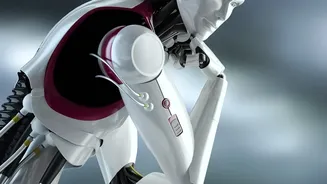







From Competitor to Collaborator
The initial reaction to seeing an AI complete a complex task in seconds can be daunting. It’s easy to feel like you’re in a race you can’t win. The most important first step is to reframe this relationship. AI isn’t your competitor; it's a tool, arguably
the most powerful one ever created for knowledge work. The goal is not to outperform AI at computational or repetitive tasks, but to augment your own abilities with its power. This mindset shift from replacement to augmentation is crucial. While AI excels at finding patterns in vast datasets and generating output, it lacks genuine understanding, consciousness, and real-world judgment. Your value moves from executing the task itself to defining, guiding, and refining the work that the AI does.
Focus on 'Why' and 'How'
AI is exceptionally good at answering the 'what' — what are the key points of this document, what is the code for this function, what are some ideas for a marketing campaign. Human expertise, however, is becoming more centered on the 'why' and the 'how'. Why are we pursuing this strategy? What are the ethical implications of this decision? How can we best serve the user's emotional needs? These are questions that require context, strategic thinking, and emotional intelligence — all areas where humans maintain a distinct advantage. Learning in the AI era means developing your ability to ask better questions and to think critically about the answers you receive. An AI can generate a list of business strategies, but it takes a human to decide which one aligns with the company's long-term vision and values.
Use AI as Your Personal Tutor
One of the most transformative ways to keep learning is to use AI as an infinitely patient and knowledgeable tutor. Instead of just asking it for an answer, ask it to teach you a concept. You can prompt it to explain a complex topic in simple terms, create analogies, or even generate a study guide and practice questions. For example, you could ask, "Explain the concept of machine learning like I'm a 10-year-old," and then follow up with, "Now, create five real-world examples and a short quiz for me." This Socratic method of interacting with AI, where you engage in a dialogue and challenge its outputs, turns passive information consumption into an active learning process. It’s a way to build foundational knowledge faster, freeing up your mental energy for higher-order thinking.
Double Down on Human-Centric Skills
While AI automates certain analytical and creative tasks, it amplifies the need for skills it cannot replicate. These include critical thinking, creativity, complex problem-solving, and emotional intelligence. Over-reliance on AI can degrade these skills if they are not actively cultivated. Critical thinking is perhaps the most vital, as AI can generate plausible-sounding but inaccurate or biased information. The ability to evaluate, question, and verify AI-generated output is now a fundamental competency. Similarly, true creativity isn't just generating novel combinations; it’s about making connections between seemingly unrelated ideas, a skill that remains deeply human. Empathy, leadership, and the ability to build relationships are also becoming more valuable as routine tasks are automated, allowing more time for genuine human interaction.
Adopt a 'Learn-It-All' Mindset
In a world of rapid technological change, the most durable skill is the ability to learn itself. The 'know-it-all' expert of the past is being replaced by the 'learn-it-all' professional who is driven by curiosity and adaptability. This means embracing a state of continuous learning, not as a chore, but as a core part of your job. It involves being open to new technologies, experimenting with new tools, and constantly asking how you can work smarter. Learning is no longer about a finite period of education early in life; it’s an ongoing process of skill development and adaptation. The future belongs to those who can learn, unlearn, and relearn effectively throughout their careers, using tools like AI to accelerate the process.