

The Rise of the 'Cobot'
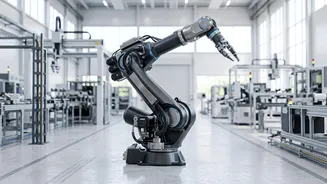
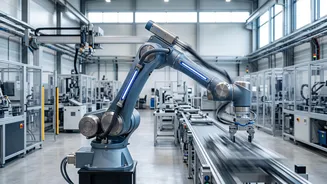
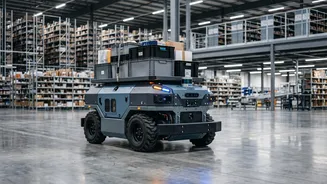
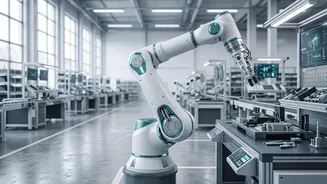
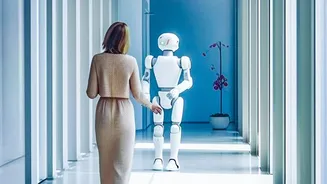
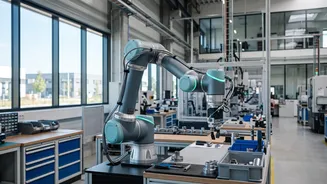
For decades, industrial robots were powerful, fast, and dangerous, locked away in cages to prevent accidents. But a new generation, known as collaborative robots or 'cobots', has emerged with a different mandate: to work in shared spaces with humans.
These machines are designed to assist with strenuous, repetitive, or monotonous tasks, freeing up human workers for more complex problem-solving and quality control. Studies have shown that this partnership can dramatically increase efficiency, with one MIT study noting an 85% reduction in worker idle time when humans and robots collaborate. The goal is a seamless blend of human ingenuity and robotic precision, creating a more flexible and productive environment.
The Limits of Traditional Safety
Making it safe for a powerful machine to work next to a person is a major engineering challenge. Most cobots achieve this through features like force-limiting sensors that stop the robot if it bumps into something, speed monitoring that slows it down when a person is near, and rounded designs with no pinch points. While effective, this approach is largely reactive. The robot stops after making contact, or slows down based on simple proximity. This prevents serious injury but doesn't create a truly intelligent or adaptive partnership. For robots to handle delicate, complex tasks alongside people, they need to move beyond simply avoiding collisions and develop a more nuanced understanding of their environment.
Eka's Leap Forward: Robots That 'Feel'
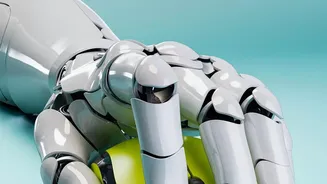
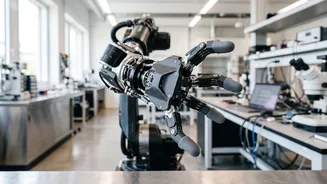
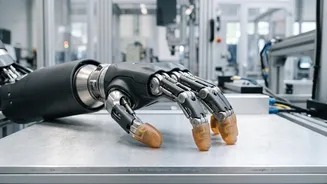
This is where Eka Robotics, a US-based startup founded in 2024 by MIT professor Pulkit Agrawal and robotics expert Tuomas Haarnoja, comes in. Having recently secured $150 million in funding, the company is not just building another cobot; it's building a new kind of robotic intelligence. Their breakthrough is a 'Vision-Force-Action' (VFA) model. Instead of relying primarily on cameras (vision), Eka's robots deeply integrate force sensors, giving them a sense of touch. The AI doesn't learn by mimicking human demonstrations. Instead, it learns physics by running thousands of hours of trial-and-error scenarios in a simulated environment, developing what can be described as an 'intuition' for how objects behave.
Performance That Changes the Game
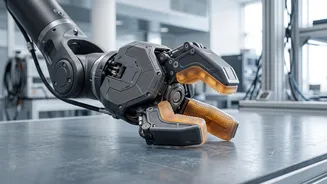
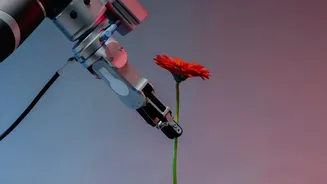
This innovative approach allows Eka's robots to generalize their skills across different objects, tasks, and environments. It helps them solve the 'last millimeter problem'—the final, delicate act of grasping an object, where a sense of force is critical. The results are impressive. Eka reports its robots can pick and place a wide variety of objects at a rate of 1,500 per hour, more than double the average human speed of about 600 per hour, with over 95% accuracy. The same robot that can sort items with superhuman speed can also perform delicate tasks like screwing in a lightbulb or inserting wires, demonstrating a versatility that has been a long-standing goal in the robotics industry.
Redefining Safe and Collaborative Work
Eka's technology redefines what 'safe' means in human-robot collaboration. Safety is no longer just about stopping on impact. It's about having a robotic partner that can adapt to the unexpected because it understands the physical world. A robot that can feel its grip slipping and adjust accordingly, or handle an object with just the right amount of force, is inherently more reliable and safer to work alongside. This moves the relationship from simple coexistence to true collaboration, where the robot can be trusted with more complex and valuable tasks. This shift is crucial for bringing automation to industries like warehousing, advanced manufacturing, and even food processing, where dexterity and adaptability are essential.