




What Is This 'Blaze Star'?
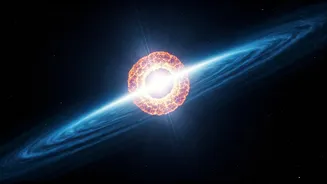
The star system grabbing headlines is called T Coronae Borealis (T CrB), located about 3,000 light-years from Earth. It's not a single star, but a binary pair locked in a dramatic cosmic dance. One partner is a red giant, an old, bloated star that has
swelled up, puffing its outer layers into space. The other is a white dwarf, the incredibly dense, hot core of a star that has died. This white dwarf is a cosmic vampire, gravitationally siphoning hydrogen gas from its larger companion. This volatile relationship is what sets the stage for the spectacular celestial show we're about to witness.
A 'Recurrent Nova' Explained
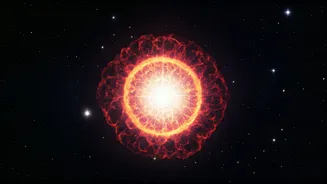
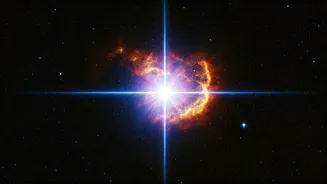
A nova, Latin for 'new', is a sudden, massive explosion from a star, causing it to brighten dramatically. In the case of T CrB, the white dwarf pulls so much hydrogen from the red giant that the gas piles up on its surface. Over time, the pressure and temperature of this stolen material become so intense that it triggers a runaway thermonuclear explosion. This is the nova. The term 'recurrent' means this process repeats. While most novae are thought to be one-off events from our perspective, T CrB puts on a show roughly every 80 years. The last time it erupted was in 1946, making its 2024 appearance a truly generational event.
Why This Event Is So Special
Most novae are too faint or too far away to be seen without a powerful telescope. The T CrB event is different. When it erupts, it is expected to brighten from its usual magnitude of +10 (far too dim for the naked eye) to about magnitude +2. This is as bright as Polaris, the North Star. For a few days, it will look like a brand new, bright star has suddenly appeared in the sky, before it gradually fades back into obscurity over the following weeks. There are only a handful of known recurrent novae, and T CrB is one of the brightest and most predictable, giving sky-gazers a rare and accessible front-row seat to cosmic drama.
How to Spot the New Star
You won't need a telescope, but you will need to know where to look. The nova will appear in the constellation Corona Borealis, or the 'Northern Crown'. This is a small, C-shaped arc of stars located between the bright stars Vega (in the constellation Lyra) and Arcturus (in Boötes). The best way to find it is to use a stargazing app on your phone to locate Corona Borealis. The nova will be a 'new' point of light within this semi-circle of stars that wasn't there before. The eruption is predicted to occur sometime between now and September 2024. As the event is unpredictable, the best advice is to familiarise yourself with the constellation now and check it on clear nights.
The Best Way to Watch from India
Corona Borealis is visible from India, rising in the east in the evenings and tracing a path across the sky overnight. For the best view, get away from city lights. Light pollution will wash out all but the brightest stars, and you want a dark sky to appreciate the contrast of the 'new' star. While you can see it with your naked eye, a simple pair of binoculars will give you a much richer view and help you appreciate its brightness against the backdrop of fainter stars. Find a comfortable spot, let your eyes adjust to the darkness for about 15-20 minutes, and look towards the Northern Crown. Patience is key, as the exact date of the explosion remains a thrilling mystery.