




India’s Most Complex Lunar Mission Yet
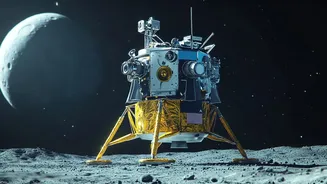
Chandrayaan-4 represents a monumental leap in India's space exploration capabilities. While its predecessor achieved a historic soft landing near the lunar south pole, this new mission aims to perform a full round trip. The primary objective is to land on the Moon,
collect up to three kilograms of lunar soil and rock (regolith), and return it safely to Earth for scientific analysis. This would make India only the fourth country in the world to achieve this feat, after the United States, the former Soviet Union, and China. The mission, which received cabinet approval in September 2024, is not just about bringing back souvenirs; it’s about demonstrating a host of new technologies crucial for future deep-space and human spaceflight missions.
A Five-Module Spacecraft and a Two-Launch Strategy
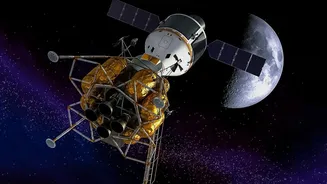
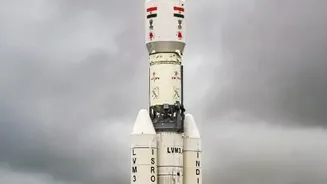
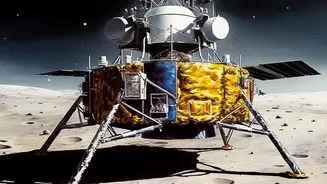
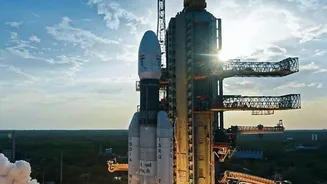
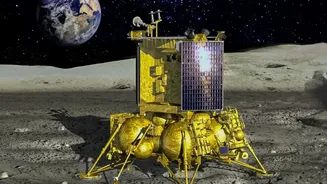
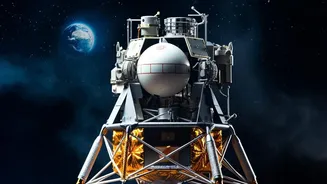
The sheer complexity of a sample return mission means Chandrayaan-4 cannot be launched on a single rocket. Its total weight is simply too much for even India's most powerful launch vehicle, the LVM3. To solve this, ISRO has designed a mission involving five separate modules: a Propulsion Module, a Descender Module (lander), an Ascender Module, a Transfer Module, and a Re-entry Module. These modules will be launched in two separate stacks using two LVM3 rockets. The first launch will carry the Descender and Ascender, while the second will carry the other three modules. This dual-launch strategy is a first for an Indian deep-space mission.
Docking in Orbit and Landing on the Moon
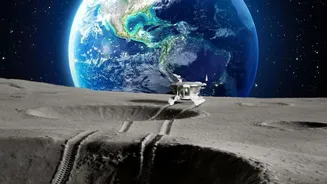
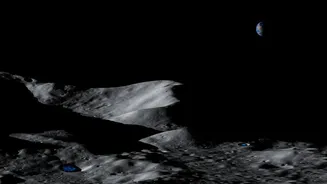
Once in Earth's orbit, the two stacks will perform a delicate and crucial manoeuvre: autonomous rendezvous and docking. This will be the first time ISRO attempts to dock two spacecraft in orbit, a technology essential for building future space stations and conducting complex missions. After docking to form a single integrated spacecraft, the Propulsion Module will fire its engines to push the combined stack towards the Moon. Upon reaching lunar orbit, the Descender and Ascender modules will separate and begin their powered descent to a pre-selected landing site near the Moon's south pole, a region known as Mons Mouton.
The Robotic Collection Process
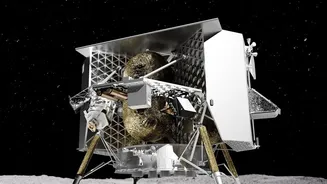
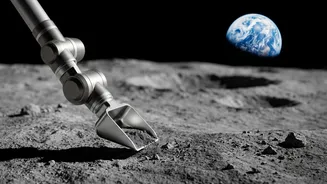
After a safe and soft landing, the collection process begins. The Descender Module will deploy a robotic arm to scoop up surface samples. It will also feature a drilling mechanism to collect subsurface material, providing a more comprehensive look at the Moon's geology. These samples, totalling around 2-3 kg, will be carefully transferred into sealed containers aboard the Ascender Module to protect them from contamination during the long journey home. This entire process will be monitored via cameras, allowing scientists on Earth to oversee the delicate operation from millions of kilometres away.
The Journey Home
Once the samples are secured, the Ascender Module will ignite its engines, using the Descender as a launchpad to lift off from the lunar surface. It will then rendezvous and dock with the Transfer and Re-entry modules still waiting in lunar orbit. The precious sample container will be transferred to the Re-entry Module. The Transfer Module will then fire its own engine for the trans-Earth injection, setting a course back home. As it approaches Earth, the Re-entry Module will separate, blazing through the atmosphere before landing safely on Earth, delivering its pristine cargo of lunar soil to eager scientists.
Why Bring Back Moon Rocks?
Studying lunar samples in sophisticated labs on Earth offers scientific insights that remote instruments simply cannot match. These samples from the geologically diverse south pole could hold clues about the origins of the Earth-Moon system, the presence of water ice, and the availability of valuable resources. For India, the scientific return is immeasurable. It will not only elevate the country's standing in the global scientific community but will also pave the way for more advanced exploration, including the Gaganyaan human spaceflight program and the eventual goal of sending Indian astronauts to the Moon.