
The Sun’s Temper: What is Space Weather?
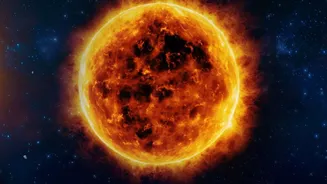
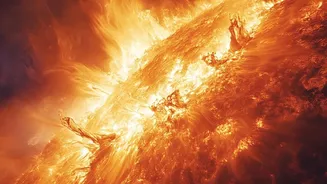
Space weather refers to the changing conditions in space, primarily driven by the sun’s activity. This isn't weather like rain or snow, but rather a constant flow of charged particles called the solar wind. Sometimes, the sun releases massive bursts of energy.
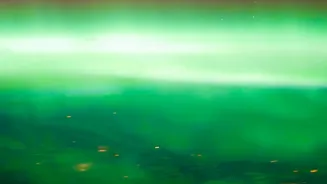
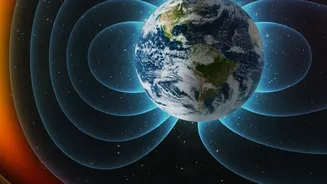
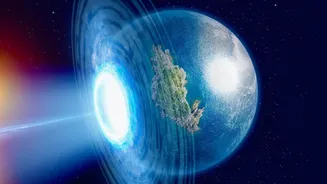
These can be solar flares, intense flashes of radiation that reach Earth in about eight minutes, or coronal mass ejections (CMEs), which are giant clouds of solar plasma and magnetic fields that travel through space and can reach Earth in one to three days. When these powerful events head our way, they interact with Earth's protective magnetic field, creating geomagnetic storms that can have significant consequences.
The High-Tech Domino Effect
Our modern, technology-dependent society is particularly vulnerable to severe space weather. A strong geomagnetic storm can induce powerful currents in the ground, known as geomagnetically induced currents (GICs). These can flow into high-voltage power lines, overwhelming transformers and potentially causing large-scale, long-lasting blackouts, as happened in Quebec in 1989. Beyond the grid, satellites are at risk from increased radiation and atmospheric drag, which can damage electronics and alter orbits. This disruption can cripple GPS navigation, affecting everything from aviation and shipping to financial transactions and ride-sharing apps that rely on precise timing signals.
Our Eyes on the Sun
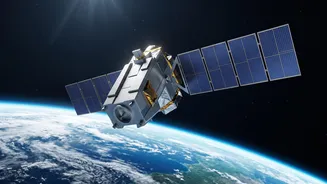
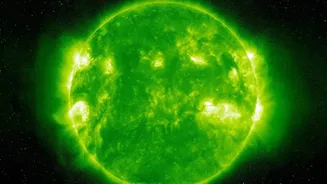
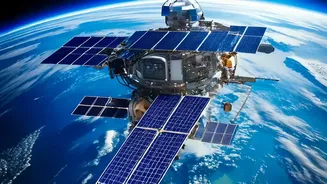
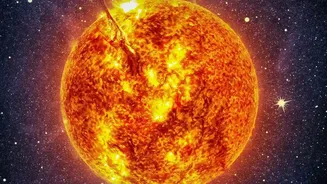
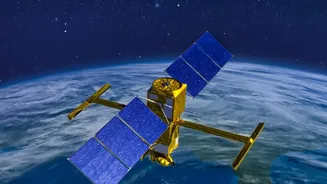
To protect against these threats, scientists maintain a constant watch on the sun. A network of space-based observatories acts as our primary early-warning system. Satellites like NASA's Solar and Heliospheric Observatory (SOHO) and the GOES series provide continuous, real-time data on solar activity. These spacecraft monitor the sun for sunspots, which are often precursors to flares, and can directly image CMEs as they erupt from the solar atmosphere. This gives forecasters crucial time—from hours to days—to predict the arrival and potential intensity of a solar storm.
India’s Watchful Eye: The Aditya-L1 Mission
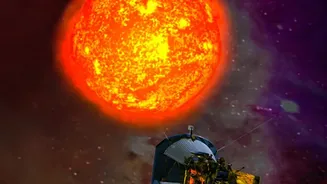
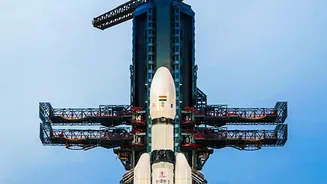
India has significantly bolstered global space weather monitoring with its Aditya-L1 mission. Launched by ISRO, the spacecraft is positioned at Lagrange Point 1 (L1), a gravitationally stable spot about 1.5 million kilometres from Earth. This unique vantage point gives it an uninterrupted view of the sun, without any eclipses or occultations. Aditya-L1 is equipped with seven sophisticated payloads. Four of these instruments perform remote sensing, observing the sun's photosphere, chromosphere, and corona, while three conduct in-situ measurements, studying particles and magnetic fields in the solar wind as they pass the spacecraft. This provides crucial data for understanding solar dynamics and improving space weather forecasts.
From Forecast to Action
Once a threatening solar event is detected, the data flows to space weather prediction centres around the world, like NOAA's Space Weather Prediction Center in the US and the Regional Warning Centre (RWC) in India. Forecasters use sophisticated models to analyse the data and issue watches, warnings, and alerts to government agencies and affected industries. This information allows critical infrastructure operators to take protective measures. Power grid operators can redirect power flows or temporarily take sensitive equipment offline to prevent damage from GICs. Satellite operators can put their spacecraft into a protective 'safe mode' to shield delicate electronics. Airlines may also reroute flights, particularly those over polar regions, to avoid communication blackouts and elevated radiation levels.