



Not Your Average Household Dust
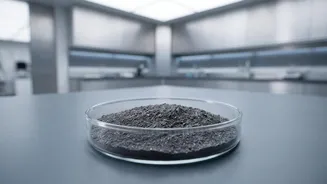
The grey powder covering the Moon, known as regolith, is fundamentally different from the dust on Earth. Billions of years of micrometeorite impacts, without wind or water to smooth the particles, have created a surface covered in tiny, sharp, glass-like
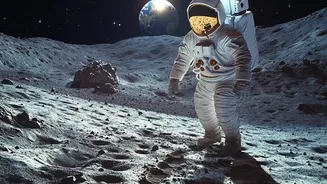
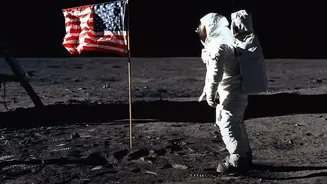
shards. This material is also electrostatically charged by solar radiation, causing it to cling stubbornly to every surface it touches. During the Apollo missions, astronauts found the dust to be a pervasive nuisance. It scratched helmet visors, abraded layers of their spacesuit boots, clogged mechanisms, and caused vacuum seals on sample containers to fail. Once inside the lunar module, it caused what came to be known as “lunar hay fever,” with astronauts reporting sore throats, watery eyes, and nasal congestion.
The High-Velocity Threat
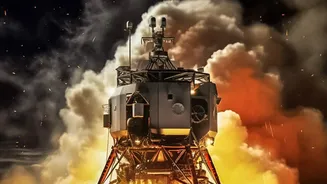
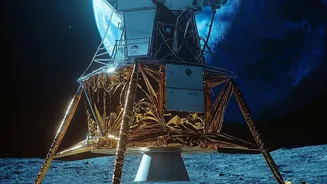
The problem is magnified exponentially during a landing. A lander’s rocket engines eject exhaust gases at supersonic speeds, turning the fine lunar dust into a high-velocity sandblaster. This doesn’t just obscure the pilot's view in the critical moments before touchdown, a problem reported by several Apollo crews; it poses a significant danger to both the lander itself and any nearby assets. The evidence for this destructive force is stark. When the Apollo 12 crew landed near the uncrewed Surveyor 3 probe in 1969, they found the nearby probe had been blasted by dust particles, eroding its surfaces. With NASA planning to establish a long-term presence on the Moon with its Artemis program, this phenomenon presents a critical risk. A single landing could potentially damage scientific instruments, habitats, rovers, or even another spacecraft parked nearby.
Simulating the Moon on Earth
To understand and mitigate these risks, NASA can't wait until it gets to the Moon. The agency is conducting a series of complex ground tests to simulate the physics of plume-surface interaction. At NASA's Langley Research Center, engineers are firing rocket engines at simulated lunar soil (regolith simulant) inside a massive 60-foot spherical vacuum chamber. These tests, lasting only a few seconds each, are designed to create a trove of data for researchers. A battery of instruments, including stereo cameras similar to ones used on recent commercial lunar landings, measures everything from how craters form under the plume to the speed, angle, and distribution of the ejected particles. This data is crucial for validating and improving the computer models that predict how dust will behave during future landings.
Developing Solutions for Artemis and Beyond
The ultimate goal of this testing is to develop effective mitigation strategies. The data will influence the design of future human landing systems, ensuring they can operate safely and reliably. Solutions could involve everything from new landing techniques to building specialized landing pads on the lunar surface to contain the blast. NASA is also investing in active dust-fighting technologies. One promising innovation is the Electrodynamic Dust Shield (EDS), a system that uses an electric field to actively repel dust particles from surfaces. This technology was successfully tested on a commercial lander in 2025, proving it could clear dust from solar panels and other critical surfaces. Other technologies, such as using an electron beam to charge and remove dust, are also under development to protect everything from spacesuits to the future Lunar Gateway station.