




Worlds of Fire and Fury
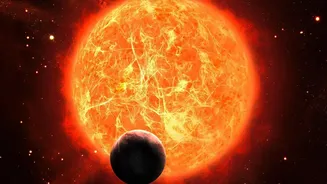
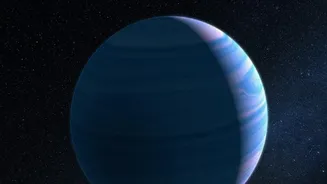
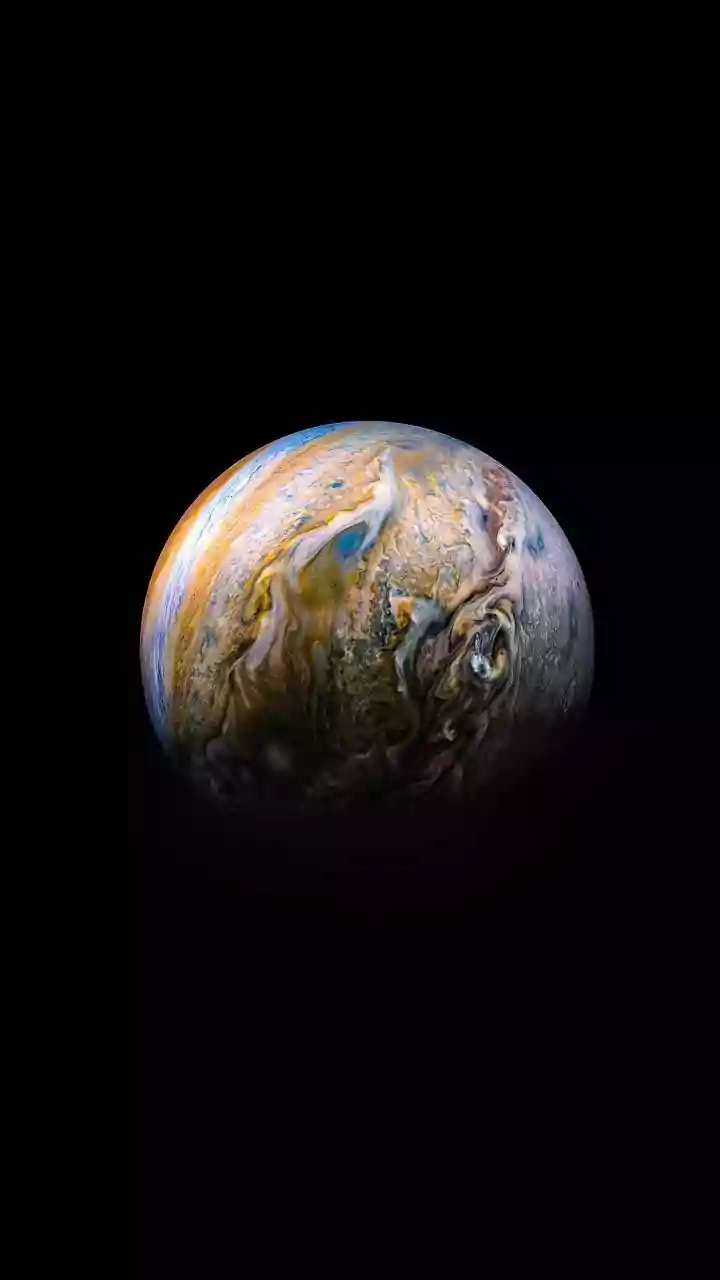
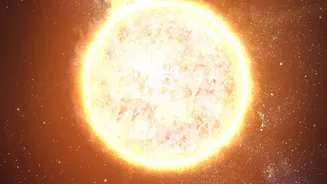
Across the galaxy, a class of exoplanets known as 'ultra-hot Jupiters' orbit perilously close to their stars. These gas giants are tidally locked, meaning one side perpetually faces the star's blistering heat while the other remains in permanent darkness.
This creates a world of unimaginable extremes. On the 'dayside' of a planet like WASP-76b, located about 640 light-years away, temperatures can soar above 2,400 degrees Celsius. This is hot enough to vaporize not just water, but metals like iron, turning them into a gas that fills the atmosphere.
How to See Rain Light-Years Away
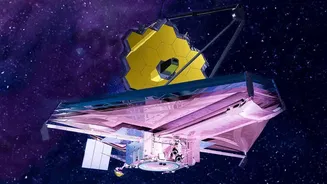
Detecting weather on a planet hundreds of light-years from Earth sounds impossible, but astronomers use a clever technique called spectroscopy. By observing the light from a star as an exoplanet passes in front of it, scientists can see which wavelengths of light are absorbed by the planet's atmosphere. Each element has a unique chemical 'fingerprint', allowing instruments like the ESPRESSO spectrograph on the European Southern Observatory's Very Large Telescope to identify the composition of these alien skies. It was this method that first revealed a strong signature of iron vapour at the 'evening' edge of WASP-76b, where day turns to night.
A Planet Where It Rains Iron
The most startling discovery on WASP-76b was what happens to this vaporized iron. The extreme temperature difference between the planet's day and night sides drives ferocious winds. These winds carry the iron gas from the ultra-hot dayside over to the cooler nightside. As the atmosphere cools to a still-scorching 1,500 degrees Celsius, the iron vapour condenses back into liquid, forming clouds of molten iron that then fall as rain. Astronomers deduced this because while iron is abundant at the planet's 'dusk' terminator, it's missing by 'dawn', meaning it has rained out during the night.
Winds Faster Than Sound
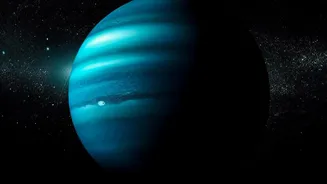
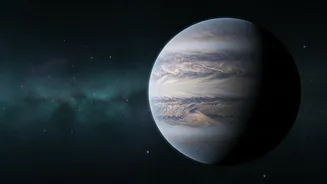
The extreme conditions don't stop with metallic rain. On another gas giant, WASP-127b, astronomers have measured the fastest planetary jet stream ever recorded. Winds at the equator of this 'puffy' planet, which is larger than Jupiter but far less dense, reach speeds of up to 33,000 kilometres per hour. That's nearly 30 times faster than the strongest hurricanes on Earth and about 18 times faster than the gales on Neptune, home to the fastest winds in our solar system. By tracking the movement of molecules in the planet’s atmosphere, scientists found that one side was rushing toward us while the other was speeding away, revealing the presence of a powerful, supersonic equatorial jet stream.
Why We Study These Cosmic Storms
Studying these violent and exotic worlds does more than just satisfy our curiosity about the universe's extremes. These ultra-hot Jupiters are natural laboratories for understanding planetary climates under conditions we could never replicate. By mapping their atmospheric dynamics and chemical processes, scientists can refine their models of how planets form and evolve. It helps explain the incredible diversity of planets that exist beyond our solar system and provides a broader context for understanding the atmospheric conditions that make planets like our own Earth so unique.