


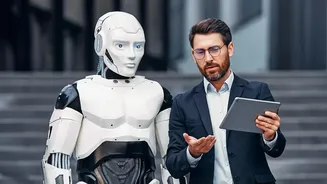
As AI tools become standard workplace partners, it’s easy to imagine a fully automated future. But the reality is more collaborative. The most effective and responsible AI systems rely on a critical component: the human in the loop.
What is the Human-in-the-Loop?
Human-in-the-loop (HITL)
is a model where people actively participate in an AI-driven process. Instead of letting AI run completely on its own, humans are strategically placed at key checkpoints to review, correct, or approve the AI's work. This isn't about micromanaging the machine; it's about combining the speed and data-processing power of AI with the contextual understanding, ethical judgment, and common sense that humans provide. Think of it as a partnership: AI does the heavy lifting of analysing data or generating content, while a person provides the final sign-off, especially when the stakes are high. This ensures that automation doesn't sacrifice accuracy, safety, or accountability.
Why AI Still Needs Human Oversight
Despite incredible advances, AI models can struggle with ambiguity, bias, and edge cases that fall outside their training data. They lack a true understanding of the world and can misinterpret nuance or context, leading to plausible-sounding but incorrect or inappropriate outputs. Human review is essential for catching these errors. For example, an AI might flag a financial transaction as fraudulent based on patterns, but a human analyst can consider the broader context before blocking a customer's account. Oversight is critical in high-risk areas like medicine, finance, and law, where an AI error could have significant real-world consequences. Ultimately, humans remain accountable for decisions, and review processes create a clear line of responsibility.
The Guardian, the Trainer, and the Judge
Human reviewers play several distinct roles. As 'Guardians', they ensure AI outputs are ethical, safe, and aligned with company values and regulations, preventing biased or harmful outcomes. For instance, a human reviewer would screen AI-assisted hiring recommendations to ensure fairness. As 'Trainers', humans provide feedback that improves the AI over time. By correcting errors or ranking outputs, they teach the model to generate better, more reliable results in the future. This feedback loop is crucial for refining AI performance. Finally, as 'Judges', humans handle ambiguity. When an AI is uncertain or encounters a novel situation, a person steps in to make the final call, applying nuanced judgment that machines lack.
Making Review a Control, Not a Checkbox
Simply adding a human approval step doesn't guarantee meaningful oversight. For a review to be effective, the reviewer needs adequate time, the right information, and the authority to reject or modify the AI's output. A workflow where a person is asked to rubber-stamp hundreds of AI decisions per hour is not a real control. Effective systems are designed to flag only the cases that truly need a human eye, based on risk, confidence scores, or the significance of the decision. For example, an AI might be allowed to draft internal emails autonomously but require approval before sending a customer a message with a financial commitment. This risk-based approach prevents bottlenecks while ensuring accountability where it matters most.
The Future is Human-AI Collaboration
The goal of AI in the workplace isn't to replace humans, but to augment their capabilities. By automating repetitive and time-consuming tasks, AI frees up people to focus on strategic, creative, and interpersonal work where they excel. The most productive and innovative companies will be those that foster a collaborative environment where humans and AI work as a team. This partnership combines the efficiency of machines with the indispensable qualities of human intelligence: critical thinking, empathy, and ethical reasoning. As AI becomes more integrated into our daily work, the ability to work alongside it—knowing when to trust it and when to question it—will become a core professional skill.