



What Are Super-Earths?
First, let's break down the terminology. A 'super-Earth' isn't just a bigger version of our world, but a class of planet we don't even have in our own solar system. These are exoplanets with a mass higher than Earth's but substantially lower than that
of our ice giants, Uranus and Neptune. They can be rocky, ocean worlds, or a mix of both, and astronomers estimate they make up nearly a third of all known exoplanets. This makes them a critical target for study. Because we have no local examples, every discovery about them—from their composition to their atmosphere—fills a huge gap in our understanding of how planets form across the galaxy.
Webb's Powerful Infrared Gaze
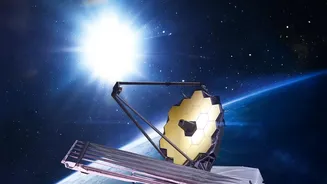
So how exactly does Webb see an atmosphere on a planet light-years away? The telescope is an expert at a technique called transmission spectroscopy. When an exoplanet passes in front of its host star, a tiny fraction of the starlight filters through the planet's atmosphere. Different gases and molecules absorb light at specific infrared wavelengths, leaving a unique chemical fingerprint that Webb's sensitive instruments can detect. By analyzing this 'barcode' of missing light, scientists can determine what the atmosphere is made of. The telescope's incredible stability and precision allow it to capture these minute signals, doing for exoplanets what a prism does for sunlight—breaking it down into its constituent parts to reveal its secrets.
Weather on an Alien World
The latest findings are moving beyond just identifying gases and are starting to map 'atmospheric patterns'. This means scientists are detecting evidence of weather and climate on these distant worlds. For example, on one ultra-hot super-Earth, TOI-561 b, Webb found that the dayside temperature was significantly cooler than expected if it were just bare rock. This suggests a thick atmosphere is circulating heat from the scorching, permanently sun-facing side to the cooler, dark side. This process of heat distribution is a fundamental atmospheric pattern, hinting at strong winds and dynamic climate systems on a planet that might otherwise be a molten wasteland.
A 'Wet Lava Ball' World
The case of TOI-561 b, a planet once thought too extreme to hold onto any gas, is particularly groundbreaking. The data suggests it may have a 'secondary' atmosphere, one that is being constantly replenished. Scientists theorize the planet has a vast ocean of molten magma on its surface. This magma ocean could be 'outgassing'—releasing gases that form a thick, volatile-rich atmosphere. This creates a strange, dynamic system where the atmosphere is essentially being recycled by the planet's molten surface, earning it the nickname of a 'wet lava ball'. The discovery challenges long-held theories that planets orbiting so close to their stars would have their atmospheres stripped away by intense radiation.
The Search for Habitability
While molten lava worlds are not candidates for life, these discoveries are crucial stepping stones. Proving that rocky planets can retain thick atmospheres under extreme conditions is a huge win. A planet's atmosphere is a key ingredient for habitability; it provides pressure for liquid water to exist, shields the surface from harmful radiation, and can stabilize temperatures. The greater mass and gravity of super-Earths may give them an advantage in holding onto their atmospheres over billions of years, potentially making them more stable environments for life to evolve. By studying these extreme examples, scientists learn what to look for when they point Webb at cooler, more Earth-like worlds in their stars' habitable zones.