





The Rise of the AI Meeting Assistant
In today's fast-paced work environment, AI meeting assistants have emerged as a powerful tool for productivity. Services like Otter.ai, Fireflies.ai, and Microsoft Copilot can join your virtual meetings, providing real-time transcription, identifying
speakers, and even generating summaries with key takeaways and action items. The appeal is obvious: a perfect, searchable record of every conversation without having to type a single word. This technology promises to free up attendees to participate more fully in discussions, knowing that every detail is being captured for later reference. For large-scale meetings or for those who couldn't attend, these automated records can be an invaluable resource, offering a scalable and efficient way to disseminate information.
The Case for Automated Efficiency
The primary advantages of AI assistants are speed and convenience. They can transcribe hours of audio in minutes, a task that would take a human counterpart significantly longer. This makes them incredibly cost-effective, especially for organisations that require high volumes of transcription. The resulting text is instantly searchable, allowing you to pinpoint specific discussions or decisions from weeks ago in seconds. Furthermore, these tools promote accessibility, providing crucial support for team members with disabilities or those who may have missed a meeting. The ability to automatically generate summaries and delegate action items helps streamline post-meeting workflows and ensures accountability.
The Hidden Costs of AI
Despite their benefits, AI assistants come with significant drawbacks. Privacy and data security are chief among them. When you use a third-party AI tool, you are uploading potentially sensitive conversations to external servers, which could be used for training AI models or be vulnerable to breaches. Accuracy is another major hurdle. AI transcription struggles with complex accents, technical jargon, background noise, and overlapping speakers, often leading to errors that require time-consuming manual correction. This can create a false sense of security, as inaccuracies in the official record could lead to serious misunderstandings. Over-reliance on AI can also stifle the open and informal exchange of ideas.
The Enduring Power of Pen and Paper
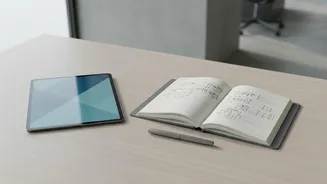
While it may seem old-fashioned, the act of writing by hand has profound cognitive benefits that typing and recording cannot replicate. Research has consistently shown that taking notes by hand improves memory and recall. Studies using EEG have found that handwriting activates more complex and widespread brain patterns related to learning compared to typing. The slower pace of writing forces you to listen more actively, process information, and summarize key concepts in your own words. This “encoding effect” helps cement information in your memory more effectively than the passive act of verbatim transcription. Handwritten notes are also a space for unfiltered thought—a place to doodle connections, jot down questions, and capture the nuances that an AI would miss.
Finding the Productive Middle Ground
The choice between AI and handwriting isn't a binary one. The most productive professionals are learning to create a hybrid system that leverages the strengths of both. For large, formal meetings where a complete record is essential, letting an AI assistant handle the transcription can be a lifesaver. This frees you up to use a pen and paper not for transcription, but for synthesis. While the AI captures what was said, your handwritten notes can capture what mattered: the hesitation before a key decision, a subtle disagreement, or a question that needs a follow-up. Think of the AI as your archive and your notebook as your strategic command centre. Use the AI for perfect recall and searchability, and use your handwritten notes to process ideas, connect concepts, and track personal insights that give context to the raw data.