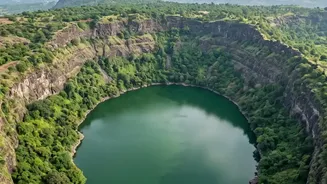






In Maharashtra’s Buldhana district lies a sight that is truly otherworldly. A near-perfect circular lake, shimmering with green water, sits nestled in a lush forest. This is Lonar Lake, a place where cosmic history meets unique biology.
A Scar from the Cosmos
Tens of thousands
of years ago, a meteorite weighing an estimated two million tonnes slammed into the Deccan Plateau at a speed of around 90,000 km/h. The resulting hypervelocity impact carved out a crater nearly 1.8 kilometres wide and 150 metres deep. For years, its location in a vast plain of volcanic basalt led geologists to believe it was a volcanic crater. However, in the 1970s, the discovery of maskelynite, a type of glass that only forms under the extreme pressure of an impact, confirmed its extraterrestrial origins. This makes Lonar one of the few known impact craters in the world formed in basaltic rock, a geological feature that has made it a valuable analogue for studying craters on Mars and the Moon.
A Lake of Strange Chemistry
Over millennia, rainwater filled the crater, but with no outlet, the water became a unique chemical soup. Lonar Lake is one of the few lakes in the world that is both highly saline and highly alkaline, with a pH level reaching as high as 10.5. This dual nature is a scientific curiosity. The lake is essentially two different water bodies in one; a neutral outer region with a pH of around 7, and an alkaline inner zone with a pH of about 11. This unusual composition creates an environment hostile to most life, yet it is the perfect home for a very specific and resilient group of microorganisms.
The Mystery of the Pink Water
In June 2020, Lonar Lake captured global attention when its usually green waters mysteriously turned a vibrant shade of pink almost overnight. Scientists determined the cause was a combination of factors. Lower water levels due to a hot, dry season increased the lake's salinity. This created the perfect conditions for a population explosion of salt-loving microbes called Haloarchaea, which produce a pink pigment. This bloom, possibly combined with carotenoids produced by algae like Dunaliella salina under stress, was responsible for the dramatic colour shift. After the rains arrived and diluted the water, the lake returned to its familiar green.
A Hub for Extreme Life
The lake's extreme environment makes it a natural laboratory for studying extremophiles—organisms that thrive in conditions that are deadly to most other life forms. The water and sediment host a rich diversity of microbes, including bacteria and archaea that are of great interest to scientists. Some of these microorganisms produce enzymes that can function in highly alkaline environments, which have potential biotechnological applications. The study of these life forms not only provides insight into Earth's own biodiversity but also informs the search for life on other planets, where similar extreme conditions might exist.
A Heritage of Science and Spirit
Lonar Lake is not just a scientific wonder; it is also a site of deep cultural and historical importance. Designated a National Geo-heritage Monument, it was also declared a Ramsar site in 2020, recognising its significance as a wetland. In late 2026, it was added to the prestigious list of the 'Third 100' IUGS Geological Heritage Sites. The area around the crater is dotted with temples dating back to the 10th-12th centuries, many built in the Hemadpanti style. Local legend connects the crater's formation to the story of Lord Vishnu defeating a demon named Lonasura, from which the name 'Lonar' is derived. This blend of cosmic accident, unique biology, and ancient human faith makes Lonar Lake a truly unparalleled destination.