

Why Venus? Earth's Hostile Sister
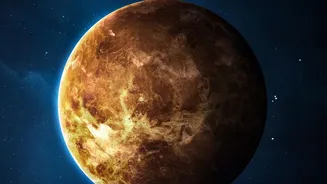
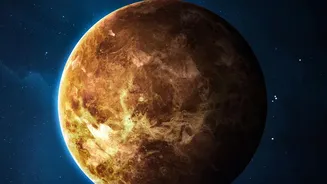
Venus may be our closest planetary neighbour, but it’s far from hospitable. Its atmosphere, composed of over 96% carbon dioxide, creates a runaway greenhouse effect, pushing surface temperatures to a scorching 467°C—hot enough to melt lead. The atmospheric
pressure at the surface is over 90 times that of Earth's, equivalent to being 900 meters underwater. Shrouded in thick clouds of sulfuric acid, the planet’s surface is impossible to see with conventional telescopes. Yet, these very extremes are what make Venus a compelling scientific target. By studying its dramatic climate, scientists hope to better understand how Earth-like planets evolve and gain insights into the long-term effects of greenhouse gases, serving as a cautionary tale for our own world.
Shukrayaan: India's Next Interplanetary Leap
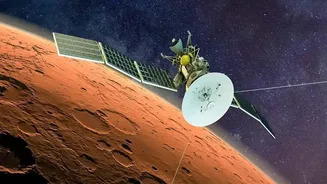
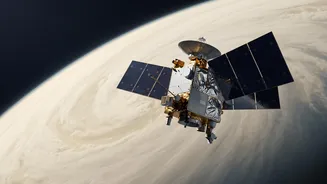
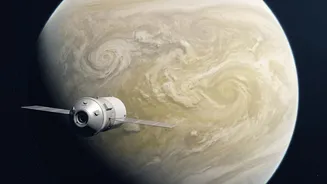
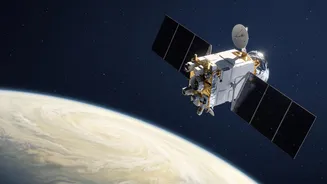
Following the monumental successes of the Chandrayaan mission to the Moon and the Mangalyaan mission to Mars, the Indian Space Research Organisation (ISRO) is setting its sights on Venus. The Shukrayaan-1 mission, named after the Sanskrit word for Venus, represents India's first dedicated journey to the second planet from the sun. Scheduled for a potential launch in March 2028, the mission involves sending an orbiter packed with scientific instruments to circle Venus. This endeavour places India among an elite group of space agencies that have explored this challenging world, reinforcing the nation's capabilities in deep-space exploration.
The Scientific Toolkit Aboard
To peer beneath the thick Venusian clouds and analyse its atmosphere, Shukrayaan-1 will carry a payload of around 100 kg, comprising approximately 19 advanced instruments from India and international partners. A key instrument is a high-resolution Synthetic Aperture Radar (SAR), which can penetrate the dense cloud cover to map the planet's surface and study its geological features, such as volcanoes and lava flows. Another first for Venus exploration will be a ground-penetrating radar designed to investigate the shallow subsurface. Other sensors will include thermal cameras, mass spectrometers, and atmospheric analysers. These tools are designed to measure wind speeds, study the composition of the atmosphere, investigate the interaction with solar wind, and monitor for lightning.
The Hunt for Chemical Clues
The primary goal of Shukrayaan's sensors is to decipher the complex chemistry of Venus. The atmosphere is predominantly carbon dioxide and nitrogen, with trace amounts of sulfur dioxide, water vapour, and other compounds. The mission will investigate the structure of the sulfuric acid clouds and study the dynamics of the super-rotating atmosphere, where winds whip around the planet much faster than the planet itself rotates. International payloads, like the Venus InfraRed Atmospheric Gases Linker (VIRAL) from Russia and France, will contribute to this goal. Another instrument, the Venusian Neutrals Analyzer, developed in collaboration with Sweden, will study how the solar wind interacts with the upper atmosphere. These investigations aim to build a complete picture of the planet's climate history and understand what led to its current, inhospitable state.