






A Doctor, Pilot, and Now, Astronaut
Anil Menon’s journey to the stars is a story of remarkable dedication. Born to an Indian father and a Ukrainian mother, Menon grew up in Minneapolis, Minnesota. His impressive resume includes a degree in neurobiology from Harvard, a medical degree from Stanford,
and extensive experience as an emergency medicine physician. But his expertise doesn’t stop there. Menon is also a colonel in the U.S. Space Force and a former flight surgeon for both NASA and SpaceX. At SpaceX, he was the first flight surgeon, helping to launch the company's first astronauts and developing the medical program to support future human missions. This unique blend of medical and aerospace experience made him an ideal candidate for NASA's astronaut corps, which he officially joined in 2024 after two years of intensive training.
The Mission: A Laboratory in Orbit
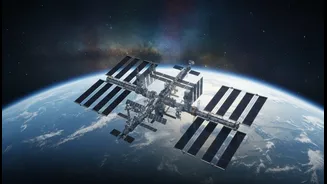
On July 14, 2026, Anil Menon launched aboard a Soyuz spacecraft for an eight-month mission to the International Space Station (ISS) as a flight engineer for Expedition 75. While any trip to space is historic, Menon’s role is especially significant. The ISS is the world's premier orbiting laboratory, and the experiments conducted there are fundamental to planning for long-duration deep-space exploration, such as NASA's Artemis missions to the Moon and future journeys to Mars. Menon's mission involves conducting a wide array of scientific research and technology demonstrations aimed at overcoming the primary obstacles to sending humans farther from Earth than ever before.
The Human Body: The Final Frontier
One of the biggest challenges for deep-space travel is the human body itself. In the microgravity environment of space, astronauts experience rapid physiological changes that mimic accelerated aging on Earth. Bone density drops at a rate of 1-2% per month, muscles atrophy, body fluids shift, and the immune system becomes compromised. Additionally, outside Earth's protective magnetic field, exposure to cosmic radiation increases cancer risk and can damage the central nervous system. As a physician, Menon is uniquely qualified to investigate these effects. A key part of his mission is studying the physiological toll of long-duration spaceflight, examining how microgravity impacts blood flow, vein structure, and blood composition. This research is not just about keeping astronauts safe; the findings can provide invaluable insights into conditions like osteoporosis, muscle wasting, and immune disorders on Earth.
Developing a Hospital in Space
On a three-year mission to Mars, there is no option for a quick return to Earth for medical treatment. Astronaut crews must be self-sufficient. Menon's work directly addresses this challenge. He is involved in testing technologies that could become critical during deep-space missions, such as a system for producing intravenous (IV) fluids from the station's drinking water. He is also performing ultrasound investigations using augmented reality and artificial intelligence, which could one day eliminate the need for a medical expert on Earth to guide the procedure. The role of a flight surgeon, which Menon previously held, is to oversee astronaut health before, during, and after missions, and his hands-on experience as an astronaut now provides critical data on how to manage medical events in real-time, millions of miles from home.
Paving the Way for a New Generation
Menon follows in the footsteps of other pioneering astronauts of Indian origin, including Rakesh Sharma, the only Indian citizen to travel to space, and NASA astronauts Kalpana Chawla and Sunita Williams. His mission serves as an inspiration, demonstrating the vital contributions individuals from diverse backgrounds make to the global endeavor of space exploration. As humanity prepares for its next giant leap, the research conducted by astronauts like Anil Menon is laying the essential groundwork. His work aboard the ISS is not just a single mission; it is a crucial investment in the future, ensuring that when humans finally walk on Mars, they can do so as safely as possible.